

In commercial office complexes, industrial manufacturing plants, data centers, and multi-specialty hospitals across Delhi NCR, standby diesel generator (DG) sets and high-voltage electrical transformers produce immense thermal heat alongside deafening mechanical acoustic noise.
Engineers face an engineering paradox: diesel generator radiators require massive volumes of continuous outdoor intake air (often exceeding 25,000 to 50,000 CFM) to prevent engine overheating and emergency shutdown. However, environmental municipal regulations (such as Central Pollution Control Board / CPCB standards) mandate strict acoustic noise limits at property boundaries.
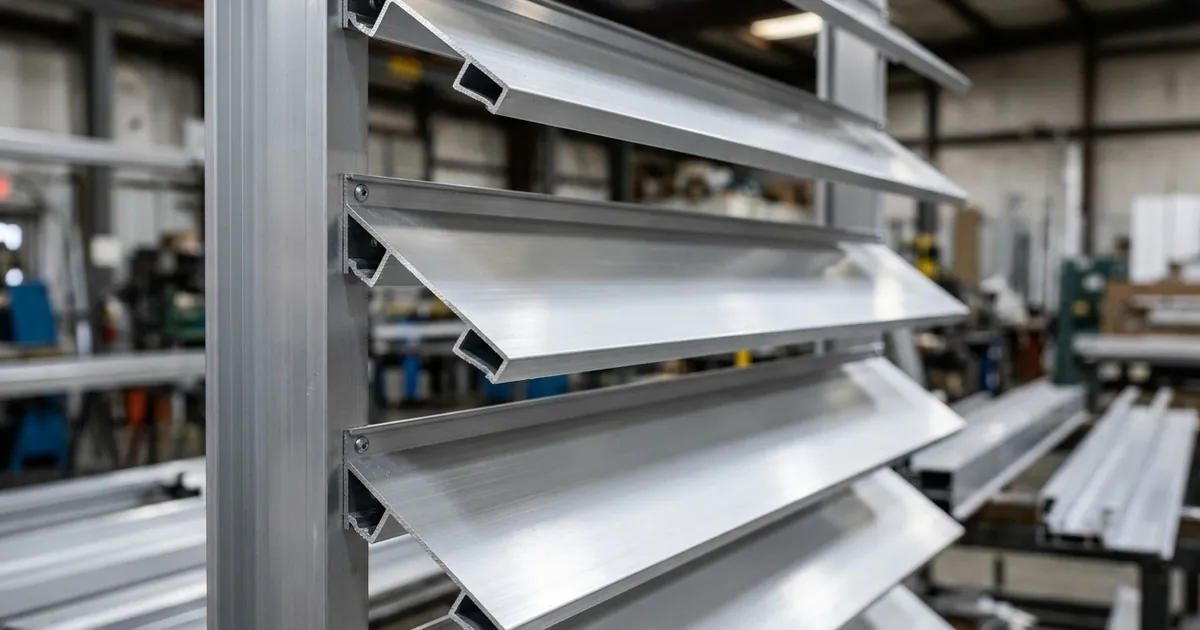
Standard architectural window louvers cannot solve this challenge—they allow sound to escape unimpeded and restrict airflow. To satisfy environmental audits, MEP contractors specify specialized industrial Jindal Aluminium acoustic louver extrusions—engineered with aerodynamic double-chevron sound-baffle profiles, non-combustible sound absorption chambers, and high free-area ventilation ratios.
How Acoustic Louvers Work: Aerodynamics & Noise Attenuation
1. Double-Chevron Sound Baffle Geometry
Features heavy extruded blades with sharp compound zigzag curves (double-chevron profile).
Primary Mechanism: Sound waves cannot travel in a straight line through the louver; they strike multiple absorbent surfaces and lose sound pressure energy (attenuating 12 dB to 25 dB noise) while allowing air to flow through.
2. Free Area & Pressure Drop Control
Engineered to maintain a high 50% to 60% free ventilation area across the entire wall opening.
Primary Mechanism: Keeps static pressure drop under 40 Pa at radiator face velocities (3.0 m/s to 4.5 m/s), completely preventing radiator fan backpressure and engine derating.
3. Class A Driving Rain Protection
The upward-slanted drainage hooks integrated into each blade catch wind-driven monsoon raindrops.
Primary Mechanism: Water drains horizontally into vertical side jamb drainage troughs and exits onto the exterior sill, preventing short circuits on high-voltage electrical panels inside.
4. Structural Frame & Bird Mesh Integration
Heavy-gauge peripheral perimeter channels measuring 150mm to 300mm deep with integrated rear slots.
Primary Mechanism: Holds stainless steel 304 wire mesh (12mm square) preventing pigeons, rodents, and debris from entering plant rooms.
Standard Industrial Louver Sizing & Specification Matrix
Below is a dimensional reference table detailing industrial acoustic and plant room louver extrusions available through Imperial Metal Mart in Delhi NCR:
| Louver Section Series | Outer Frame Depth (mm) | Blade Pitch Spacing (mm) | Nominal Wall Gauge (mm) | Target Industrial Application |
|---|---|---|---|---|
| Single-Bank Weather Louver | 100.0 mm Depth | 75.0 to 100.0 mm Pitch | 1.80 to 2.00 mm | Standard air handling unit (AHU) intake, parking basement exhaust |
| Double-Bank Weather Defense | 150.0 mm Depth | 65.0 mm Staggered Pitch | 2.00 to 2.50 mm | Electrical substation transformer rooms, coastal building plant rooms |
| Acoustic Sound Baffle Louver | 200.0 mm Depth | 150.0 mm Pitch (Insulated) | 2.20 to 2.80 mm | Standby DG set intake air openings, chiller plant room acoustic screening |
| Heavy Double-Bank Acoustic | 300.0 mm Heavy Box | 150.0 mm Double Chevron | 2.50 to 3.00 mm | Critical hospital DG rooms, data center generators (high dB drop) |
4 Key Advantages of Extruded Aluminium Over Galvanized Steel (GI) Louvers
1. Aerodynamic Extruded Blade Contours
Sheet-metal GI louvers are bent on brake presses, creating blunt edges that generate air turbulence and high air-resistance whistling. Extruded aluminium allows curved aerofoil entry leading edges and precision rain-trap lips that smooth airflow.
2. 100% Rust-Proof in Acidic Diesel Exhaust
Diesel exhaust contains sulfur oxides that mix with rainwater to form dilute acid. Galvanized steel louvers rust through within 3 to 5 years. Extruded aluminium naturally resists sulfur fumes and moisture without degrading.
3. One-Third the Weight on Building Openings
A large 3m × 3m plant room louver in steel weighs hundreds of kilograms, requiring heavy structural steel lintels and hoist rigging. Aluminium louvers can be installed by two technicians using standard masonry anchors.
4. Modular Interlocking Blade Stacking
Features integral screw-boss alignment channels that allow blades to screw directly into side jamb channels at fixed factory angles, ensuring zero assembly errors on-site.
Frequently Asked Questions
How do you calculate the required louver wall opening for a DG room?
Divide the engine manufacturer's required combustion + radiator cooling air volume (CFM) by the design face velocity (typically 500 to 700 feet per minute / FPM). Then divide that area by the louver's percentage free area (e.g. 50%) to obtain the exact gross masonry opening size required in square feet.
What standard lengths are industrial louver sections supplied in?
Jindal louver sections are supplied in standard mill lengths of 3.66 meters (12 feet) and 4.88 meters (16 feet). Imperial Metal Mart can supply precision cut blade lengths for immediate modular assembly.
Where can MEP contractors buy genuine Jindal louver profiles in Delhi NCR?
Imperial Metal Mart stocks certified Jindal Aluminium louver sections, box frames, aerodynamic blades, and bird screens at our central Paharganj wholesale warehouse in New Delhi, serving MEP and HVAC contractors across North India.
Source Industrial Louver Profiles in Delhi NCR
Imperial Metal Mart supplies genuine Jindal Aluminium louver sections, ventilation frames, and weather-defense profiles to industrial MEP contractors.