

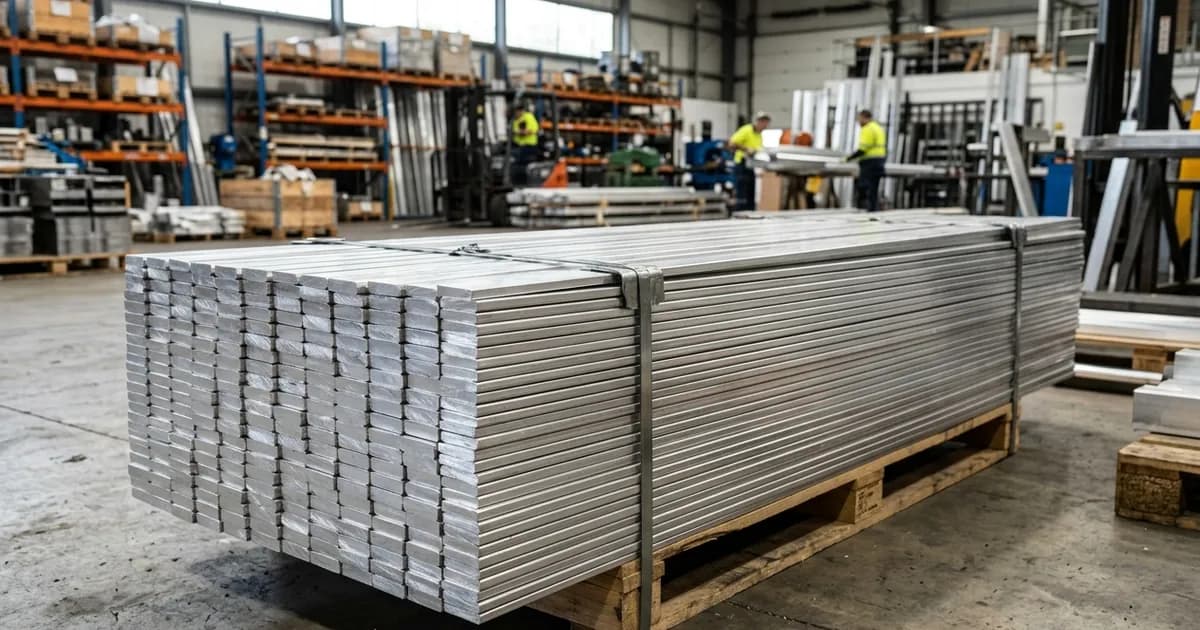
In precision machine shops and automated manufacturing plants across Delhi NCR, toolmakers consistently choose extruded aluminium industrial flat bars over mild steel for custom jigs, welding fixtures, and assembly tooling.
While steel tooling plates are notoriously heavy, slow to machine, and prone to rust, Jindal Aluminium solid industrial flats offer exceptional dimensional stability, high-speed CNC milling capability, non-magnetic properties, and superior vibration dampening.
Whether you are machining custom locator blocks, robotic end-of-arm tooling (EOAT), or CMM inspection nests, this guide breaks down the essential flat bar sizing parameters and tooling design principles.
Why Toolmakers Prefer Aluminium Flat Bars Over Steel
3x Faster Machining
Aluminium flats can be milled at spindle speeds up to 12,000+ RPM and high feed rates, drastically cutting machining cycle times and tool insert wear.
Reduced Inertia
Lightweight tooling plates reduce payload stress on robot wrist motors and high-speed CNC indexers, allowing faster indexing acceleration.
Part Protection
Aluminium fixture contact pads will never scratch or gouge delicate finished plastic, brass, or painted automotive customer parts.
Standard Industrial Flat Bar Dimensions for Fixture Building
Below is a dimensional reference table of extruded solid aluminium flat bars frequently used in industrial tooling and automation workshops:
| Width (mm) | Standard Thickness (mm) | Edge Profile | Primary Tooling & Machine Application |
|---|---|---|---|
| 25.0 mm (1.0") | 6.0, 8.0, 10.0, 12.0 mm | Sharp 90° Square | Drill bush locator blocks, small clamping toggle straps, guide rails |
| 50.0 mm (2.0") | 10.0, 12.0, 15.0, 20.0 mm | Sharp 90° Square | Robotic gripper fingers, vise jaw soft pads, vertical locator uprights |
| 75.0 mm (3.0") | 12.0, 15.0, 20.0, 25.0 mm | Sharp 90° Square | Inspection CMM staging blocks, modular fixture risers, welding stops |
| 100.0 mm (4.0") | 15.0, 20.0, 25.0, 30.0 mm | Sharp 90° Square | CNC milling sub-plates, modular grid tooling plates, angle plates |
| 150.0 mm (6.0") | 20.0, 25.0, 30.0, 40.0 mm | Sharp 90° Square | Heavy machine mounting tables, automated nest base plates, slide beds |
Key Engineering Considerations When Sizing Tooling Flats
1. Thread Engagement Depth in Aluminium
Because aluminium has a lower shear modulus than hardened steel, threaded holes for clamping bolts (e.g. M8, M10, M12) require an engagement depth of at least 1.5 to 2.0 times the bolt diameter. For high-cycle production fixtures, install stainless steel Helicoil or wire thread inserts to eliminate thread stripping.
2. Square Edge vs Full Radius Edge
For tooling and machining jigs, always specify Sharp 90-Degree Square Edge flats from the Jindal Catalogue. Square edges register flush against CNC machine vise jaws and parallel blocks without tipping.
3. Surface Face Milling Tolerances
Precision extruded aluminium flat bars exhibit tight factory extrusion tolerances conforming to IS:3965. For ultra-precision fixture sub-plates (< 0.02 mm parallelism), a single skim cut using a fly cutter or face mill on a CNC VMC achieves mirror flatness.
Common CNC Machining Applications
- Soft Jaws for CNC Vises:50mm × 20mm or 75mm × 25mm aluminium flats are cut into custom soft jaws and contoured to hold irregular castings securely without distortion.
- Pneumatic Pick-and-Place Fingers:25mm × 10mm flats are machined into lightweight gripper fingers for SCARA and 6-axis articulated assembly robots.
- Inspection & Leak Testing Nests: Non-magnetic aluminium tooling plates provide stable mounting surfaces for digital dial gauges, proximity sensors, and pneumatic leak-test manifolds.
Frequently Asked Questions
What is the standard length of Jindal aluminium industrial flats?
Jindal industrial flats are supplied in standard mill lengths of 3.66 meters (12 feet). Imperial Metal Mart can saw-cut flat bars into specific tooling block lengths or billet blocks for immediate machining.
Can aluminium flats be hard-anodized for wear resistance?
Yes. Hard-coat anodizing (40 to 50 microns) provides a surface hardness comparable to hardened tool steel (over 60 HRC surface equivalent), preventing abrasive wear in high-volume repetitive sliding jigs.
Where can machine shops in Delhi NCR source calibrated aluminium flats?
Imperial Metal Mart stocks genuine Jindal Aluminium industrial flat bars and tooling plates at our Paharganj central depot in New Delhi, serving machine shops and toolrooms in Mayapuri, Wazirpur, Okhla, and Manesar.
Source Industrial Flat Bars in Delhi NCR
Imperial Metal Mart is your authorised Jindal Aluminium stockist for precision industrial flats, CNC tooling bars, and machine sub-plates with immediate stock availability.