

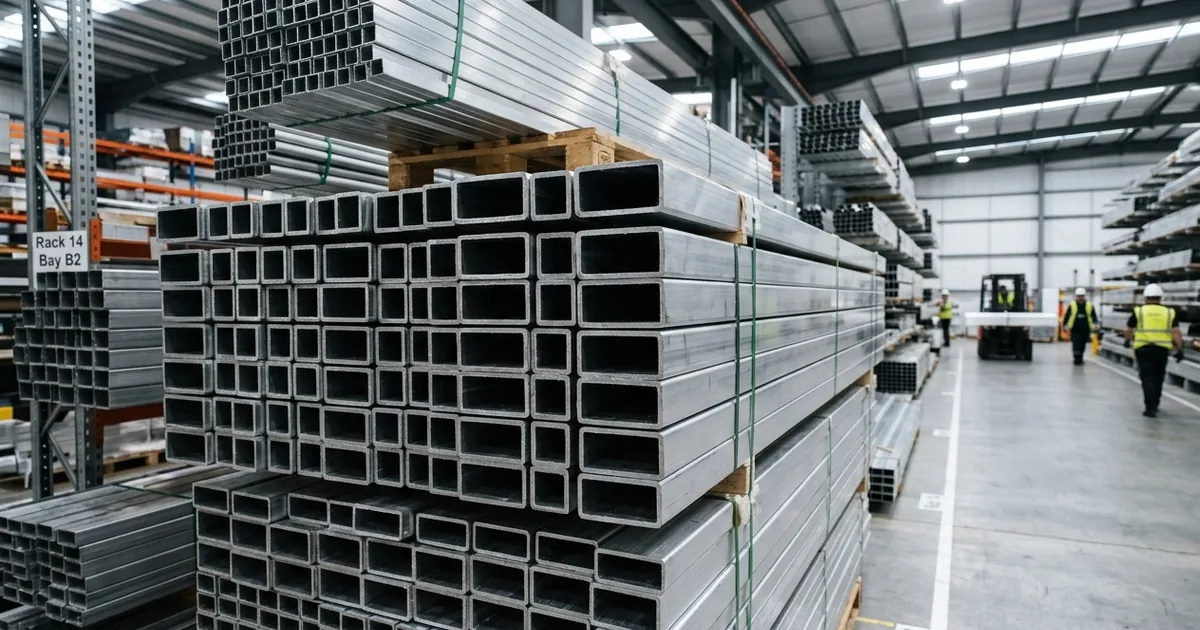
Telescopic tubular mechanisms—where sequential lengths of metal slide smoothly inside one another—are fundamental to adjustable camera booms, tripod legs, marquee tent uprights, solar array masts, and industrial extension arms.
When building sliding assemblies, mechanical fabricators consistently specify Jindal Aluminium extruded tubes over steel due to their high strength-to-weight ratio, effortless corrosion resistance, and precision extrusion dimensional tolerances.
However, creating a telescopic assembly that glides without jamming or wobbling requires precise calculation of **radial sliding clearances**, matching inner diameters (ID) with outer diameters (OD), and selecting the right tube cross-section.
Round vs Square Telescopic Tubes: Which Shape to Choose?
Depending on your mechanism requirements, both cylindrical round tubes and square hollow sections offer distinct mechanical characteristics:
1. Round Telescopic Pipes
Round cylindrical tubes allow 360-degree rotational freedom around the center axis unless keyed with an internal spline.
- Best For: Camera tripods, swimming pool skimmer poles, microphone stands, and rotating antenna masts.
- Locking Style: External collet compression twist-locks, internal expansion cams, or split-clamp collars.
2. Square Telescopic Box Tubes
Square tubes naturally lock rotation on all four flat faces, ensuring rigid alignment under torsional twist forces.
- Best For: Marquee tent leg height adjusters, modular staging frames, overhead display banners, and automation guide rails.
- Locking Style: Spring-loaded pop-up push buttons (valco pins) or cross-bolted linchpins.
Calculating Sliding Clearance: Preventing Jamming vs Wobble
The most critical engineering factor in any telescopic tube system is the radial clearance gap:
The Ideal Clearance Formula
For bare mill-finish aluminium, target an internal gap between the Outer Tube Inner Diameter (ID) and Inner Tube Outer Diameter (OD) of 0.60 mm to 1.00 mm.
• Too Tight (< 0.30 mm): Metal-on-metal galling, binding from dust or anodizing layer buildup.
• Too Loose (> 1.50 mm): Excessive play, angular slop, and rattle in the extended assembly.
Standard Telescopic Tube Nested Dimension Matrix
Below is a practical dimensional reference pairing standard Jindal extruded tube sizes stocked in Delhi NCR for multi-stage sliding frames:
| Telescopic Stage | Outer Tube Size (OD × Wall) | Calculated Inner ID (mm) | Inner Slider Tube OD (mm) | Target Application |
|---|---|---|---|---|
| Light Duty Round (Stage 1 → 2) | 25.4 mm (1.0") × 1.60 mm | 22.20 mm | 21.0 to 21.5 mm OD | Microphone booms, painting extension rods |
| Medium Duty Round (Stage 2 → 3) | 31.75 mm (1.25") × 1.80 mm | 28.15 mm | 27.0 mm OD | Flagpoles, camera tripods, outdoor shade canopies |
| Heavy Duty Round (Stage 3 → 4) | 38.1 mm (1.50") × 2.00 mm | 34.10 mm | 33.0 mm OD | Solar survey masts, stage truss support poles |
| Square Box Stage (Stage 1 → 2) | 38.0 × 38.0 mm × 2.00 mm | 34.0 × 34.0 mm | 32.0 × 32.0 mm Outer | Modular exhibition stall posts, awning supports |
| Heavy Square Stage (Stage 2 → 3) | 50.0 × 50.0 mm × 2.50 mm | 45.0 × 45.0 mm | 43.0 × 43.0 mm Outer | Heavy canopy leg stands, telescopic warehouse gates |
4 Mechanical Locking Methods for Telescopic Tubes
1. Spring-Loaded Push-Button Pins (Valco Clip)
A V-shaped leaf spring with a solid round button inserted inside the inner slider tube. It snaps cleanly into pre-drilled adjustment holes along the outer tube. Ideal for fast, tool-free field adjustment in tent frames and crutches.
2. External Split-Collet Compression Twist-Locks
A threaded polymer or aluminium collar with internal taper fingers mounted onto the outer tube lip. Rotating the outer ring squeezes the collet onto the inner tube, allowing continuous stepless height locking without pre-drilled holes.
3. Quick-Release Cam Clamps
Similar to bicycle seatpost clamps. Slitting the tip of the outer tube allows a hinged lever cam to clamp around the inner tube with a single finger flip.
4. Through-Hole Linchpins & D-Rings
For heavy structural loads (such as staging legs or scaffold braces), a hardened steel detent pin passes completely through aligned holes across both tubes and locks with a cotter ring.
Fabrication Tips: Ensuring Smooth Sliding Action
- Internal Burr Removal: Always deburr and chamfer both the inside lip of the outer tube and the outer edge of the inner tube after saw cutting to prevent scoring.
- Specify Anodized Finishes: Bare mill-finish aluminium rubs together creating aluminium oxide galling over repeated sliding cycles. An electro-chemically sealed 15 to 25 micron natural anodized surface provides hard, frictionless sliding contact.
- Delrin / Nylon Bushing Inserts: For commercial equipment, inserting a thin machined POM (Delrin) collar between the two tubes eliminates metal-on-metal friction and prevents rattle completely.
Frequently Asked Questions
Can standard Jindal tubes fit inside each other directly from stock?
Yes. The official Jindal Aluminium Catalogue features incremental gauge steps in round and square hollow extrusions. By choosing the correct wall thickness, standard stock sizes create ideal sliding telescopic pairings without custom die tooling.
What standard lengths are telescopic aluminium tubes supplied in?
Jindal tubes are supplied in standard mill lengths of 3.66 meters (12 feet) and 4.88 meters (16 feet). Imperial Metal Mart also provides in-house cold precision cutting to your required stage lengths.
Can Imperial Metal Mart supply nested tubes in Delhi NCR?
Yes. We keep extensive ready inventory of concentric round and square Jindal aluminium tubes at our Paharganj, New Delhi distribution warehouse with same-day dispatch across Delhi NCR and North India.
Source Concentric Aluminium Tubes in Delhi NCR
Imperial Metal Mart stocks genuine Jindal Aluminium round and square tubes in nested increments for mechanical fabricators and product designers.