

In power transmission, electrical distribution switchboards, Motor Control Centers (MCC), and industrial sub-stations across India, the high cost and volatility of copper have driven an irreversible industry transition toward extruded aluminium busbars.
When engineered correctly, solid aluminium flat bars deliver over 60% in direct material cost savings and a 70% reduction in conductor weight compared to equivalent copper configurations. This massive weight reduction eases switchboard mechanical framing requirements, simplifies field installation, and prevents structural strain on transformer terminations.
However, designing high-reliability aluminium busbars requires a thorough understanding of alloy selection (EC Grade vs 6063-T6), temperature rise limits, thermal creep, and joint plating techniques. In this engineering manual, Imperial Metal Mart breaks down the core technical standards governing aluminium busbar design in India.
Alloy Comparison: EC Grade (Alloy 1350) vs. Architectural Alloy 6063-T6
Electrical engineers specifying busbars must balance two opposing parameters: electrical conductivity and mechanical yield strength.
| Technical Property | EC Grade (Alloy 1350 / 1050) | Alloy 6063-T6 (Structural Busbar) | Standard Copper (Reference) |
|---|---|---|---|
| Electrical Conductivity (% IACS) | 61.0% – 61.8% | 53.0% – 55.0% | 100.0% |
| Resistivity at 20°C (μΩ·cm) | 2.78 μΩ·cm | 3.15 μΩ·cm | 1.72 μΩ·cm |
| Tensile Yield Strength (MPa) | 65 – 85 MPa (Soft) | 190 – 220 MPa (High) | 200 – 250 MPa |
| Short-Circuit Mechanical Withstand | Moderate (Requires closer insulator supports) | Excellent (High rigidity against electromagnetic surge) | Excellent |
| Density (g/cm³) | 2.70 g/cm³ | 2.70 g/cm³ | 8.92 g/cm³ (+230% heavier) |
Aluminium Busbar Current-Carrying Ampacity Chart
Below is an empirical current-carrying capacity reference table for standard single flat bars mounted vertically on edge in an unventilated switchboard enclosure at an ambient room temperature of 40°C (maximum permissible temperature rise of 50°C conforming to IS 5082 / IS 8623):
| Busbar Size (Width × Thk) | Cross-Section Area | Approx. Weight (kg/m) | Current Rating (Amps - Single Bar) | Current Rating (2 Bars in Parallel) |
|---|---|---|---|---|
| 25 mm × 3 mm | 75 mm² | 0.203 kg/m | 125 A | 220 A |
| 25 mm × 5 mm | 125 mm² | 0.338 kg/m | 180 A | 310 A |
| 30 mm × 5 mm | 150 mm² | 0.405 kg/m | 220 A | 375 A |
| 50 mm × 6 mm | 300 mm² | 0.810 kg/m | 390 A | 660 A |
| 50 mm × 10 mm | 500 mm² | 1.350 kg/m | 540 A | 910 A |
| 75 mm × 10 mm | 750 mm² | 2.025 kg/m | 750 A | 1,280 A |
| 100 mm × 10 mm | 1,000 mm² | 2.700 kg/m | 960 A | 1,620 A |
| 120 mm × 10 mm | 1,200 mm² | 3.240 kg/m | 1,120 A | 1,890 A |
*Current density generally sits between 0.8 A/mm² to 1.2 A/mm² in Indian enclosure designs. For parallel bars, maintain a spacing equal to the bar thickness (e.g., 10mm gap) to permit convective cooling.
Overcoming Joint Resistance: 4 Golden Rules for Aluminium Connections
When electrical failures occur in aluminium switchboards, 95% of issues trace back to improper bolted joints rather than the metal bar itself. Aluminium naturally forms a thin, electrically insulating oxide film (Al₂O₃) within milliseconds of exposure to air. Follow these 4 mandatory practices:
- Abrade Under Neutral Grease: Immediately before bolting overlapping joints, clean the contact mating surfaces with a stainless steel wire brush or Scotch-Brite pad immersed in electrical contact grease (petroleum jelly or specialized zinc-loaded compound). This scrubs away the non-conductive oxide layer while the grease seals out air.
- Use Belleville Conical Spring Washers: Aluminium has a higher thermal expansion coefficient than steel bolts. During peak electrical loads, the aluminium bar expands, and under rigid steel washers, it undergoes microscopic plastic deformation ("creep"). When the system cools at night, the joint loosens. Conical Belleville spring washers absorb this cyclic thermal expansion without losing clamping pressure.
- Calibrated Torque Tightening:Always use a calibrated torque wrench. An M10 grade 8.8 high-tensile bolt should typically be torqued to approximately 35–40 N·m. Over-torquing crushes the aluminium matrix, while under-torquing elevates contact micro-resistance.
- Electroplating (Tin or Silver): For critical utility substations and bimetallic junctions connecting aluminium busbars to copper breaker terminals, specifying tin-plated (8 to 12 microns) or silver-plated aluminium flat bars completely eliminates galvanic electrochemical corrosion.
Frequently Asked Questions
How much larger must an aluminium busbar be compared to copper?
To carry the identical current with equal temperature rise, an aluminium busbar requires approximately 1.5 to 1.6 times the cross-sectional area of a copper bar (because aluminium has ≈ 61% the conductivity of copper). However, because aluminium is only 30% the weight of copper, the resulting aluminium bar still weighs roughly 50% less and costs over 60% less than the copper conductor it replaces.
Can copper cables be bolted directly to aluminium busbars?
Direct contact between raw copper and bare aluminium in the presence of atmospheric humidity creates a galvanic battery, rapidly corroding the aluminium contact surface. To safely connect copper lugs to aluminium busbars, use bimetallic friction-welded lugs, tin-plated washers, or specify electro-tinned aluminium busbars.
What standard lengths do Jindal Aluminium flat bars come in?
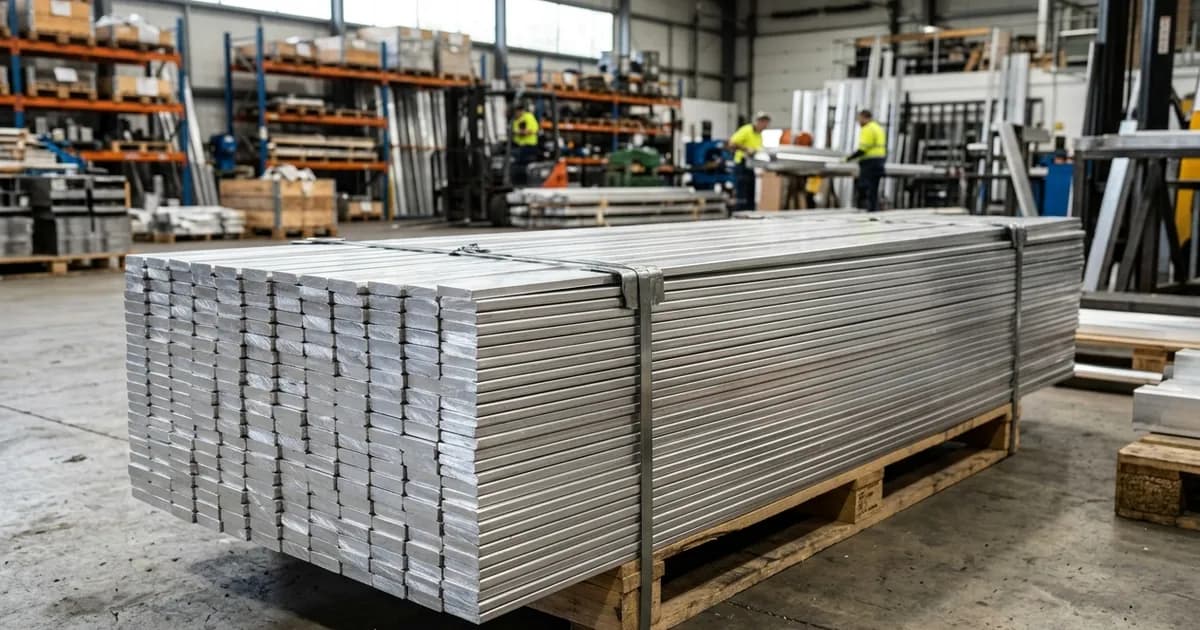
Standard Jindal aluminium flat bars are manufactured in lengths of 3.66 meters (12 feet) and 4.0 meters, packed in secure wooden crates or polythene bundles. Custom lengths for volume busway manufacturing can also be procured through Imperial Metal Mart.
Procure Certified EC Grade & 6063 Flat Bars
Imperial Metal Mart supplies genuine Jindal Aluminium flat bars, busbars, and solid sections in Paharganj, New Delhi, accompanied by official Mill Test Certificates detailing certified conductivity and mechanical properties.