

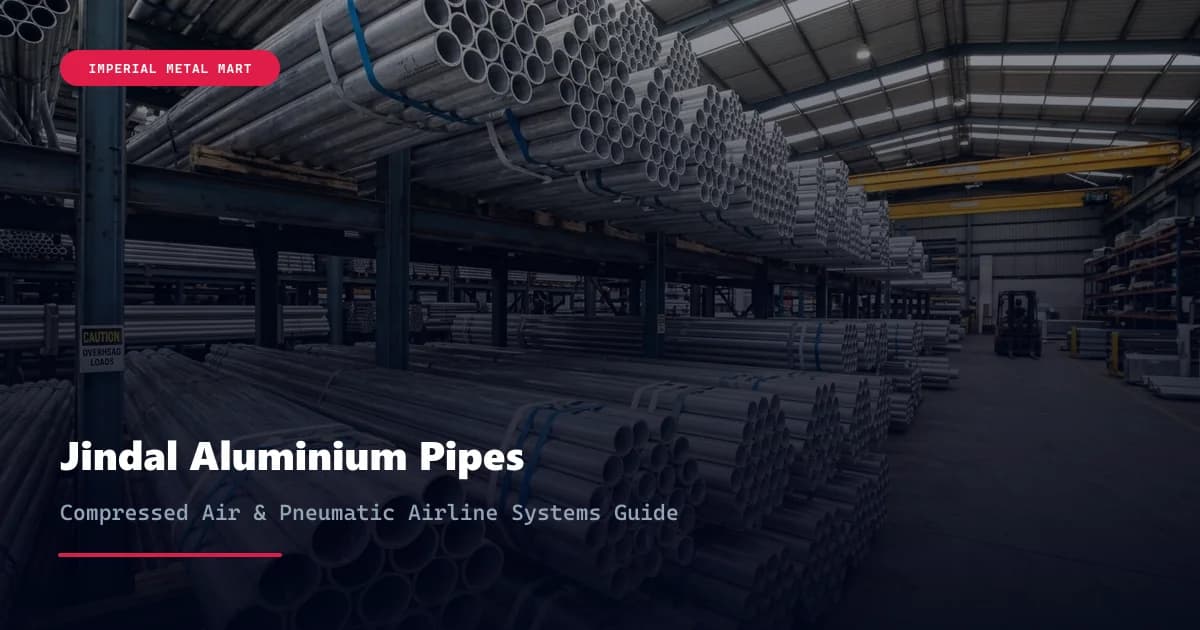
Compressed air is often referred to as the "fourth utility" in manufacturing plants, consuming up to 30% of total electrical energy in automotive assembly, textile spinning, pharmaceutical packaging, and CNC machine shops.
Historically, manufacturing facilities piped compressed air through threaded galvanized iron (GI) or carbon steel pipes. Within just two to three years of installation, moisture in the air stream oxidizes the internal steel walls, generating thick rust scale, pitting leaks, and severe friction turbulence. This rust flakes off to clog pneumatic cylinders and solenoid valves while driving massive pressure drops across the factory header.
To eliminate contamination and slash compressor electrical power waste, modern plant utility engineers specify calibrated extruded Jindal aluminium pipes—featuring mirror-smooth internal bores, zero rust formation, and modular push-to-connect union fittings.
4 Crucial Advantages of Aluminium Compressed Air Piping
1. Ultra-Low Friction Coefficient
Extruded aluminium pipe walls provide an exceptionally smooth internal surface roughness (Ra < 0.8 μm) compared to rough steel.
Primary Advantage: Maintains laminar airflow, reducing pressure drops by up to 50% across expansive 200-meter plant ring mains and cutting air compressor energy draw.
2. 100% Rust-Free Clean Air
Aluminium naturally resists oxidation and moisture corrosion without flaking or pitting.
Primary Advantage: Complies with ISO 8573-1 Class 1 air purity standards, protecting expensive pneumatic robotics, laser cutting heads, and cleanroom air tools from particulate fouling.
3. Quick-Lock Push-Fit Assembly
Eliminates on-site pipe threading, welding, hot-work permits, and curing sealants.
Primary Advantage: Pipelines connect using internal bite-ring couplers and nitrile O-ring seals, speeding up plant utility installation by up to 70% with zero leak points.
4. Easy Future Plant Expansion
Adding new machine drop lines takes minutes using specialized aluminium clamp saddles.
Primary Advantage: Operators drill a clean branch port using a pilot cutter without shutting down the entire factory header loop.
Standard Calibrated Jindal Aluminium Pipes Sizing Matrix
Below is a dimensional specification table for extruded calibrated round aluminium pipes stocked and supplied for compressed air utility systems:
| Nominal Size | Outer Diameter (OD in mm) | Calibrated Wall Thickness (mm) | Typical Airflow Range (CFM) | Recommended Network Role |
|---|---|---|---|---|
| DN20 Pipe | 20.0 mm | 1.50 mm | Up to 35 CFM | Final workstation vertical drops, individual pneumatic bench tools |
| DN25 Pipe | 25.0 mm | 1.80 mm | 35 to 80 CFM | Sub-branch headers feeding small machine cells and packaging machines |
| DN32 Pipe | 32.0 mm | 2.00 mm | 80 to 160 CFM | Secondary distribution loops feeding complete production lines |
| DN40 Pipe | 40.0 mm | 2.20 mm | 160 to 300 CFM | Medium manufacturing plant perimeter main loop ring mains |
| DN50 Pipe | 50.0 mm | 2.50 mm | 300 to 550 CFM | Heavy plant central loop lines connecting primary screw compressors |
| DN63 / DN80 Pipe | 63.0 / 80.0 mm | 3.00 mm | 550 to 1,400+ CFM | High-volume central compressor room discharge manifolds and large plant spines |
Piping Installation & Loop Design Principles
Closed-Loop Ring Main Layout
Always arrange main overhead distribution headers as a closed-loop ring main rather than dead-end branch runs. This equalizes airflow in both directions during sudden demand surges and limits velocity-induced pressure drops across distant machine stations.
Gooseneck Drop Leg Take-Offs
Vertical machine drop legs should always branch off the top of the main horizontal header using a swan-neck or gooseneck bend. This simple physical arrangement ensures that any residual moisture droplets traveling along the bottom of the pipe are captured by automatic drain traps rather than flowing downward into equipment.
Color Coding Standards
Per international plant safety standards (ISO 14726), compressed air lines are coated in Signal Blue (RAL 5012), while vacuum lines are finished in Light Grey (RAL 7035) and nitrogen lines in Signal Yellow, allowing plant technicians to instantly identify utility networks.
Frequently Asked Questions
Can standard aluminium round pipes be used with push-to-connect air fittings?
Quick-lock push fittings require calibrated outer diameter tolerances and smooth, burr-free chamfered ends to prevent slicing the internal sealing O-rings. Genuine Jindal aluminium round pipes extruded to tight dimensional tolerances (IS 3965) provide the exact outer diameter consistency needed for zero-leak pneumatic push-fit connections.
What operating pressures do aluminium compressed air pipes withstand?
Extruded aluminium pipes engineered for industrial air systems comfortably handle continuous operating pressures of 10 to 16 bar (145 to 232 PSI) across temperatures from -20°C to +70°C, providing a substantial safety factor over standard factory compressor pressures (7 to 8 bar).
Where can plant engineers source Jindal aluminium pipes in Delhi NCR?
Imperial Metal Mart stocks calibrated Jindal Aluminium round pipes and structural tubing in all standard diameters at our central Paharganj, New Delhi warehouse, with fast delivery to industrial zones across Gurgaon, Manesar, Faridabad, Noida, and Greater Noida.
Source Genuine Jindal Aluminium Pipes in Delhi
Imperial Metal Mart supplies factory utility engineers and piping contractors with certified Jindal Aluminium round pipes, seamless tubes, and hollow profiles with complete dimensional compliance.