

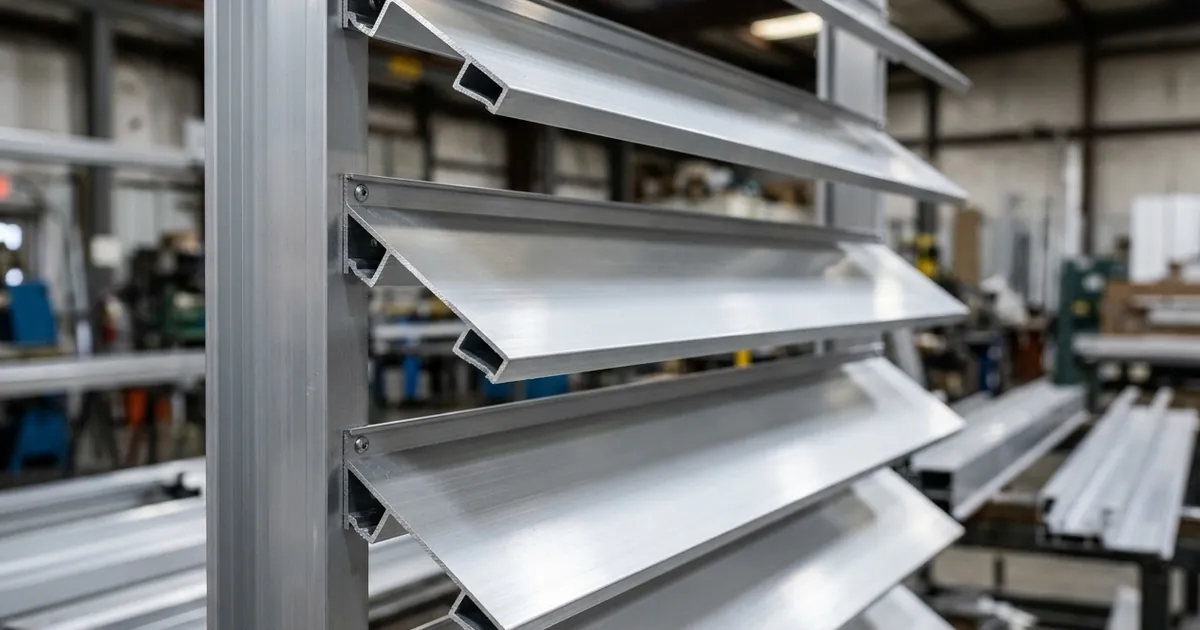
In modern building architecture, every commercial complex, residential apartment tower, hospital, and data center faces a common engineering dilemma: how to conceal mechanical plant equipment, promote high-volume natural airflow, prevent rainwater penetration, and maintain a striking contemporary facade aesthetic.
The universal architectural solution is the precision-extruded aluminium louver section. Far from being simple decorative grilles, engineered louvers are calibrated aerodynamic devices designed to manage airflow velocity, pressure differentials, solar thermal heat gain, and rain defense.
Manufactured from high-tensile 6063-T6 Jindal Aluminium extrusions, modern louvers provide decades of maintenance-free performance without rusting, warping, or rotting under Delhi's harsh weather. In this comprehensive guide, Imperial Metal Mart explores the primary louver profile types, engineering calculation metrics, and mounting applications.
The 4 Primary Types of Aluminium Louver Profiles
Depending on whether your primary objective is mechanical ventilation, rain exclusion, or visual facade enrichment, different louver die geometries are employed:
1. Aerodynamic Z-Blade Louvers
Featuring a sharp angular Z-profile (typically oriented at 30° to 45° blade pitch), these louvers maximize fresh airflow while creating a tortuous physical path that deflects driving monsoon rain droplets back outside.
- • Typical Applications: DG generator room ventilation, HVAC chiller intake grilles, lift motor rooms.
- • Standard Blade Depth: 50mm, 75mm, 100mm
- • Rain Defense Rating: Class B to Class A water rejection
2. Box / Rectangular Fin Louvers
Clean, rectilinear hollow box sections (e.g., 50x25mm, 100x50mm, or 150x50mm) mounted vertically or horizontally across building facades. They block intense diagonal solar radiation while maintaining open sightlines and giving corporate towers a sleek, structured linear rhythm.
- • Typical Applications: Luxury villa exterior screens, commercial facade elevations, parking structure facades.
- • Finishes: Architectural Anodized, Textured Charcoal Grey, Wood Grain Sublimation
3. Acoustic Sound-Damping Louvers
Deep aerodynamic blades packed internally with dense acoustic mineral wool and faced with perforated aluminium sheets. They allow air intake for industrial equipment while reducing equipment decibel noise transmission to surrounding residential neighborhoods.
- • Typical Applications: Rooftop cooling towers, industrial compressors, substation ventilation.
- • Noise Reduction: Up to 15 to 25 dB sound transmission loss
4. Motorized / Operable Louvers
Aerofoil-shaped hollow extrusions connected to mechanical pivot rods and electric linear actuators. They rotate from 0° (fully sealed, watertight roof) to 135° (fully open daylight and ventilation), ideal for bioclimatic pergola roofs and intelligent solar tracking facades.
- • Typical Applications: Luxury terrace pergolas, atrium skylights, climate-responsive building envelopes.
Key Engineering Metrics: Calculating Free Area Percentage
When an HVAC consultant sizes an intake or exhaust louver, the most critical parameter is Free Area Percentage (%). This defines the unobstructed open cross-sectional area through which air can pass without choking fans or creating excessive static pressure drops:
- Standard Commercial Louvers: Deliver approximately 45% to 55% Free Area.
- Air Velocity Limit: For intake louvers, face air velocity is typically kept below 2.5 m/s (approx. 500 FPM) to prevent aerodynamic whistling and eliminate rainwater droplets from being sucked into HVAC ducts.
- Insect & Bird Screens: Exterior louvers are routinely fitted with internal stainless steel or aluminium wire mesh (10mm bird screen or 2mm insect mesh) clamped inside the rear perimeter channel.
Installation & Structural Mounting Details
Ensuring that large-scale louver screens withstand high-velocity wind loads (up to 47 m/s in Delhi NCR) requires sound mounting engineering:
| Component | Standard Material Profile | Structural Function |
|---|---|---|
| Perimeter Outer Box Frame | Extruded Aluminium Channel (50x25mm / 75x38mm) | Fastened directly into concrete or steel subframe at 600mm centers |
| Intermediate Vertical Mullions | Aluminium Box Section (50x50mm or 100x50mm) | Prevents horizontal blade sagging on spans wider than 1.2 meters |
| Blade Retention Clips / Welds | Concealed screw flutes or clip-in brackets | Locks blades at uniform pitch angle without visible exterior screw heads |
| Bottom Weep Sill Flashing | 1.5mm Formed Aluminium Sheet / Sill Profile | Collects and sheds drained rainwater outward past the building face |
Frequently Asked Questions
Can aluminium louvers be used as safety balcony railings?
Yes. Heavy-gauge vertical or horizontal box louvers (such as 75x25mm or 100x25mm profiles with 1.8mm wall thickness) are widely utilized in residential apartment balconies as combination privacy screens, child safety railings, and sun control fins when anchored securely into structural RCC floor slabs.
Which finish lasts longest on exterior facade louvers?
For severe exterior exposures, Qualicoat Class 2 (Superdurable) Powder Coating (60 to 80 microns) or Grade AA25 Architectural Anodizing (25 microns) is strongly recommended. Both provide exceptional resistance to ultraviolet color fading, acid rain, and urban pollution chalking over 20+ years.
Does Imperial Metal Mart supply pre-fabricated louver panels or raw extrusions?
Imperial Metal Mart supplies full wholesale bundles of genuine Jindal Aluminium louver blade extrusions, perimeter outer frame channels, and mullions for on-site contractor assembly, and we can also coordinate with accredited fabrication partners for complete pre-assembled modular louver panels delivered to site.
Source Genuine Jindal Louver Profiles in Delhi NCR
Imperial Metal Mart stocks full inventories of Z-blade louvers, box sunshade profiles, and frame channels in Mill Finish, Anodized, and Powder Coated finishes.