

India is experiencing a historic rooftop solar revolution. Driven by ambitious government initiatives like the PM Surya Ghar Muft Bijli Yojana, soaring commercial electricity tariffs, and corporate ESG net-zero mandates, millions of photovoltaic (PV) modules are being installed across factory sheds, commercial warehouses, and residential rooftops.
While photovoltaic solar panels carry 25-year performance warranties, the ultimate structural integrity of any solar power plant depends entirely on its module mounting structure (MMS). If the structural racking corrodes, bends, or loses clamping torque, the entire multimillion-rupee solar asset is put in jeopardy.
Historically, contractors used heavy hot-dip galvanized iron (GI). Today, leading solar Engineering, Procurement, and Construction (EPC) firms have shifted to extruded aluminium solar mounting profiles. Offering zero rust, 70% lower dead weight on roofs, and modular assembly speed, aluminium provides the ideal 25-year mounting solution. In this guide, Imperial Metal Mart explores profile types, alloy selection, and wind-load design.
Why Aluminium Crushes Galvanized Iron (GI) for Rooftop Solar
Comparing structural performance over a 25-year operating lifecycle highlights why aluminium is the global gold standard:
| Engineering Factor | Anodized Aluminium (Alloy 6063/6005) | Hot-Dip Galvanized Iron (GI) |
|---|---|---|
| Corrosion Lifespan | 25+ Years (Natural self-healing oxide film) | 7 to 12 Years (Red rust starts once zinc layer depletes) |
| Structural Roof Dead Weight | ≈ 2.70 g/cm³ (Minimal rooftop load) | ≈ 7.85 g/cm³ (+290% heavier dead load) |
| Installation Method | 100% Modular slide-nut channels (Zero welding) | Site drilling and bolting; cut edges destroy zinc coating |
| Recycle Value at End of Life | High scrap salvage recovery (> 85% of market value) | Low scrap value |
The 4 Essential Profiles of an Aluminium Solar Mounting System
An engineered solar racking setup relies on precision extruded shapes that lock together without site welding:
1. Solar Guide Rails
Extruded longitudinal beams (typically 40x40mm, 50x30mm, or 60x40mm) running horizontally beneath rows of solar panels. Designed with internal top T-slots for clamp fixation, bottom channels for L-feet attachment, and lateral wire routing channels.
2. Mid-Clamps & End-Clamps
Specialized extruded aluminium retention profiles. Mid-clamps secure adjacent solar modules side-by-side with an 18–20mm thermal gap. End-clamps lock down the outer perimeter panels (available in 30mm, 35mm, and 40mm heights to match solar panel frame depths).
3. L-Foot Brackets & Standing Seam Clamps
Heavy-duty extruded L-brackets fastened to corrugated industrial metal roofing via EPDM-washered self-drilling screws, providing a sturdy, watertight connection to the guide rails above.
4. Triangular Tilt Frames / Elevated Legs
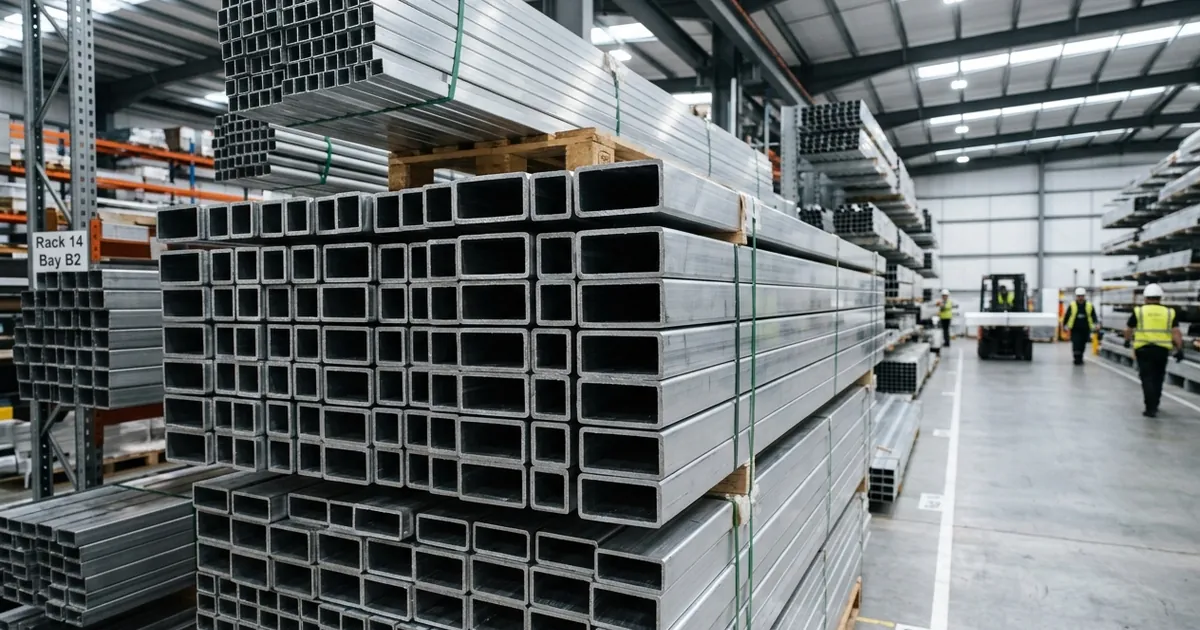
Pre-assembled triangular frameworks fabricated from aluminium square tubesand angles, orienting panels at optimal solar tilt angles (15° to 25° in North India) for maximum annual kWh generation.
Metallurgy: Alloy 6063-T6 vs. Alloy 6005A-T5 / 6061-T6
When solar arrays face severe storm gusts (up to 160 to 180 km/h conforming to Indian wind-load code IS 875 Part 3), rail deflection must not exceed L/180 to prevent micro-cracking of silicon photovoltaic cells:
- Alloy 6063-T6: Excellent for residential rooftop installations, standard rail spans under 1.5 meters, and lightweight clamp extrusions. Yield strength ≈ 214 MPa.
- Alloy 6005A-T5 / 6061-T6: The preferred alloy for large commercial industrial shed installations and long clear rail spans (1.8m to 2.4m). Contains higher magnesium and silicon content, delivering a yield strength of 260 to 276 MPa (approx. 25% stronger than 6063) to resist extreme wind uplift pressures without permanent deformation.
Anodizing Standards: Defeating Coastal Salt & Industrial Smog
Bare mill-finish aluminium exposed outdoors can suffer surface pitting from atmospheric sulfur dioxide (in industrial industrial parks) or airborne saline mist (in coastal regions).
High-quality solar mounting profiles must undergo Architectural Anodizing conforming to Grade AA15 (minimum 15 microns). This thick anodic oxide layer creates a diamond-hard, electrically insulating ceramic barrier that protects the metal matrix for 25+ years without maintenance.
Frequently Asked Questions
Can stainless steel hardware cause galvanic corrosion with aluminium solar rails?
Stainless steel (Grade 304 or 316) bolts, nuts, and washers have a relatively close electrochemical potential to aluminium in atmospheric air. When solar rails are properly anodized (15 microns), galvanic risk is negligible. However, direct contact with bare mild steel or carbon steel bolts must strictly be avoided.
What is the standard length of aluminium solar rails in India?
Standard solar rail extrusions are supplied in lengths of 3.2 meters, 4.2 meters, and 6.0 meters to accommodate standard module widths (typically 1.13m each for 540W–580W bifacial panels). Rail splices with internal slide connectors allow continuous runs of any desired length.
Does Imperial Metal Mart supply solar mounting extrusions in Delhi NCR?
Yes. Imperial Metal Mart supplies certified Jindal Aluminium solar guide rails, mid/end clamp profiles, square tubes, and structural angle sections with guaranteed alloy tempers and test certificates for solar EPCs and installers.
Source Solar Mounting Extrusions in Delhi NCR
Imperial Metal Mart stocks certified Jindal Aluminium structural rails, clamp extrusions, and mounting tubes in Alloy 6063-T6 and 6005A across Delhi NCR for immediate dispatch.