

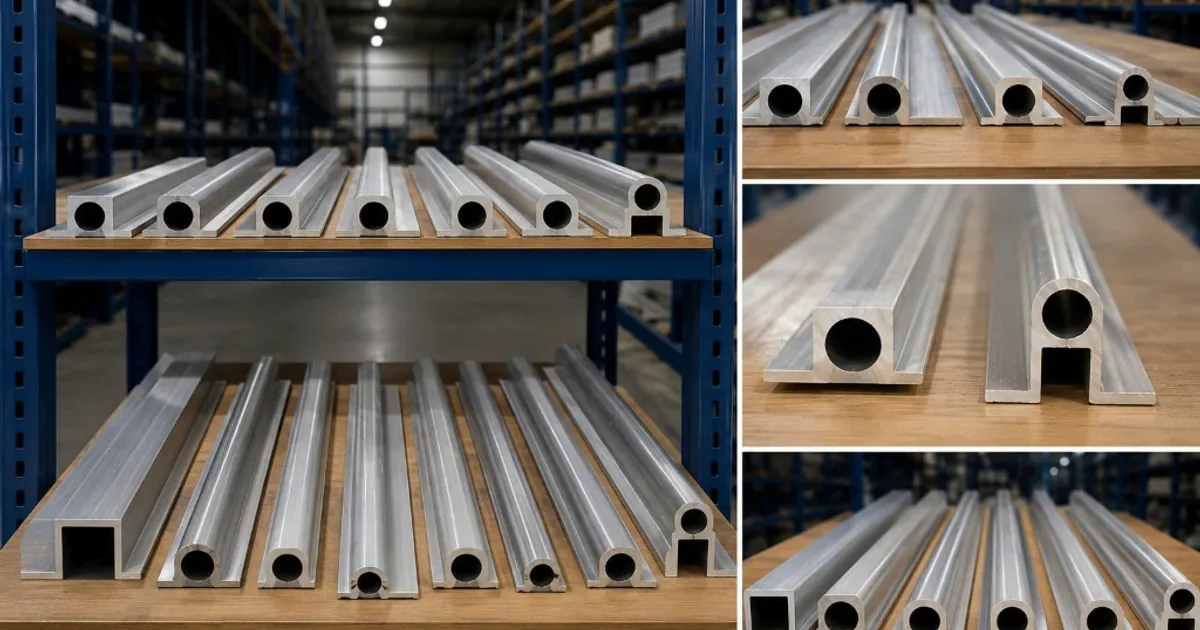
Behind every secure door, casement window sash, and bathroom partition across India operates a precision mechanical locking device: the aluminium tower bolt (barrel bolt). From high-volume hardware production clusters in Aligarh, Rajkot, and Delhi to architectural hardware OEMs across the country, millions of door fittings are manufactured every month.
While end-users only interact with the finished, polished product, the cost, operating smoothness, and mechanical reliability of architectural hardware originate in the extrusion plant. Sourcing premium Jindal Aluminium tower bolt sections allows manufacturers to reduce CNC machining scrap rates, eliminate die lines, and achieve flawless electroplated and anodized finishes.
In this manufacturing manual, Imperial Metal Mart explores the anatomy of hardware extrusion profiles, alloy metallurgy, secondary machining operations, and quality inspection standards.
The Anatomy of Tower Bolt Extrusion Profiles
A complete architectural barrel bolt assembly is fabricated from multiple precision-matching aluminium profiles extruded through specialized multi-cavity dies:
1. The Barrel Body Base Profile
A continuous hollow extruded shape featuring an integral central cylindrical chamber (where the bolt slides), flanked by flat lateral mounting flanges with pre-extruded countersunk screw drill grooves.
Critical Metric:Inner barrel bore diameter must maintain a tight tolerance (±0.05mm) to ensure smooth bolt glide without lateral rattling.
2. Solid Shoot Bolt Rod
Solid round extruded rods (typically 9.5mm (3/8"), 12mm (1/2"), or 16mm (5/8") in diameter) that form the sliding locking pin. Extruded with high surface uniformity to eliminate abrasive friction inside the barrel.
3. Keeper Socket Section
Mounted on the door frame to capture the projecting shoot bolt. Extruded with matching external profile styling and screw flanges for visual continuity with the main body.
4. Hinge Knuckle & Leaf Extrusions
Continuous hinge profiles featuring interlocking cylindrical knuckles extruded alongside flat mounting leaves, sliced into discrete 75mm, 100mm, or 125mm butt hinges.
Metallurgy: Why Alloy 6063-T6 Dominates Hardware Manufacturing
Hardware OEMs rely on Alloy 6063 in heat-treated T6 temper for three decisive metallurgical advantages:
- Superior High-Speed Machinability: In volume bolt production, extrusions are fed into automatic multi-spindle CNC machines for rapid cutting, slot milling (for the operating knob pin), and screw hole countersinking. Alloy 6063-T6 shears cleanly without gummy burrs or tool jamming.
- Pristine Anodizing & Electroplating Response: Because 6063 has low silicon and iron impurity levels, it responds exceptionally well to chemical brightening and decorative anodizing, achieving lustrous finishes that resist salt mist and human skin acidity.
- Impact & Shear Resistance: With a tensile yield strength of ≈ 214 MPa, 6063-T6 shoot bolts easily resist forced kick-in attacks and door slamming without bending.
Secondary Manufacturing & Finishing Workflow
From raw 3.66-meter extruded bundles to boxed retail products, the manufacturing pipeline consists of 5 tightly controlled steps:
- Precision Gang Sawing: Long extrusions are sliced into standard consumer bolt lengths: 100mm (4"), 150mm (6"), 200mm (8"), 250mm (10"), and 300mm (12").
- CNC Slot Milling & Punching: A longitudinal guide slot is milled into the top of the barrel, and screw holes are punched with 90° countersinks.
- Knob Pin Press-Fitting: An ergonomic knurled brass or aluminium knob pin is pressed or threaded into the shoot bolt through the barrel guide slot.
- Spring-Ball Detent Assembly: A miniature stainless steel ball bearing and compression spring are inserted beneath the bolt, creating positive tactile clicks at fully opened and locked positions.
- Surface Finishing: Parts are chemically etched and finished in Natural Silver Anodized, Golden Electroplated (Brass Finish), Antique Bronze, or Matte Black Powder Coated.
Frequently Asked Questions
Why are aluminium tower bolts preferred over mild steel bolts?
Mild steel barrel bolts rust rapidly in humid Indian bathrooms and kitchens, seizing the bolt and leaving red oxide stains across doors. Aluminium tower bolts are 100% rustproof, immune to corrosion from bathroom moisture, 60% lighter, and offer far smoother glide mechanics.
What bundle sizes are Jindal hardware sections supplied in?
Jindal Aluminium tower bolt and hardware extrusions are supplied in standard mill-finish bundles of approximately 25kg to 50kg, wrapped in protective HDPE woven sheets in standard lengths of 3.66 meters (12 feet).
Can custom hardware die designs be procured through Imperial Metal Mart?
Yes. In addition to standard commercial barrel bolt, hinge, and handle profiles, Imperial Metal Mart assists hardware OEMs in developing proprietary custom extrusion dies through Jindal Aluminium with guaranteed die exclusivity and precision tolerances.
Source Certified Hardware Extrusions in Delhi NCR
Imperial Metal Mart supplies genuine Jindal Aluminium tower bolt profiles, solid rods, and hardware extrusion sections to OEMs and fabricators across North India.