

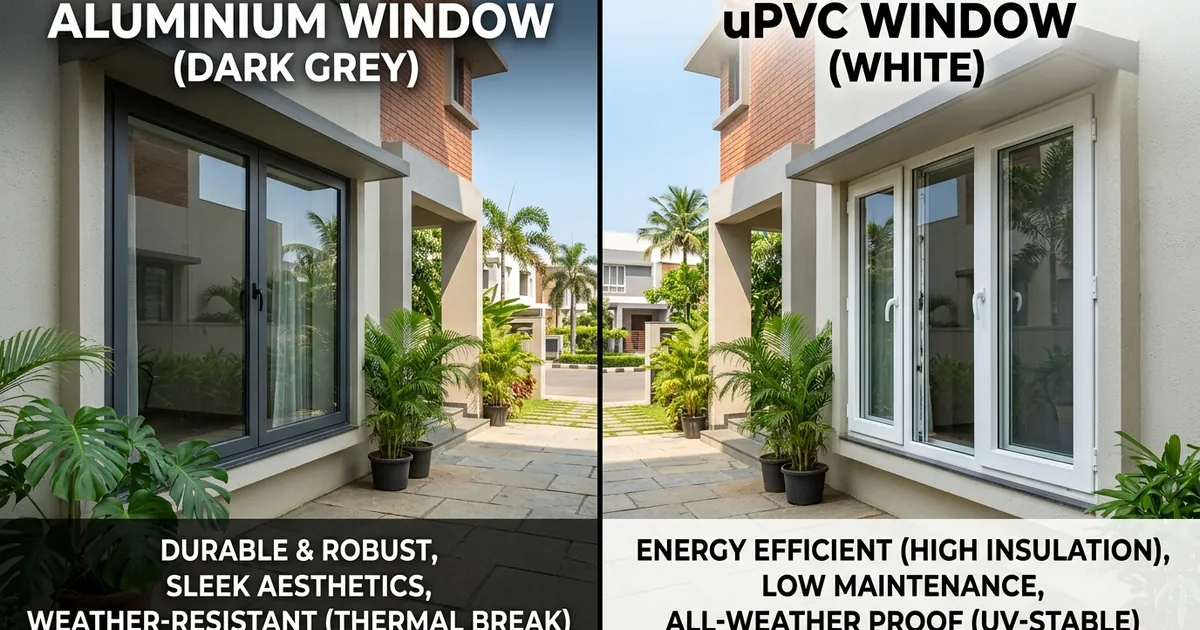
Choosing the right fenestration solution in India is uniquely challenging. The Indian subcontinent is characterized by vast climatic diversity—from the scorching, dry heat of Rajasthan to the torrential monsoons of Kerala, and the high-humidity, salt-laden air of coastal regions like Mumbai and Chennai. In modern architecture, the debate often boils down to two primary contenders: Aluminium and Unplasticized Polyvinyl Chloride (UPVC).
This comprehensive guide provides a highly technical, objective analysis of both materials. We will evaluate their structural integrity, thermal performance, acoustic insulation, maintenance requirements, and overall life-cycle cost specifically through the lens of Indian climatic zones. By the end of this article, you will have the authoritative knowledge required to make an informed decision for your residential or commercial project.
1. Understanding the Materials: The Core Composition
The Engineering Behind Modern Aluminium Windows
Historically, aluminium windows were criticized for poor thermal performance. However, contemporary architectural aluminium is a vastly different product. High-grade window profiles are typically extruded from 6063-T5 or 6063-T6 architectural aluminium alloys. These alloys contain magnesium and silicon, offering an optimal balance of structural strength, extrudability, and corrosion resistance.
Crucially, modern premium aluminium windows utilize a Thermal Break technology (typically a polyamide strip) inserted between the inner and outer aluminium profiles. This interrupts the conductive heat transfer, drastically improving the U-value (thermal transmittance) of the frame.
The Chemistry of UPVC
UPVC stands for Unplasticized Polyvinyl Chloride. Unlike standard PVC used in pipes or flexible cables, UPVC contains no added plasticizers. This makes it rigid, highly durable, and resistant to chemical erosion. For Indian climates, premium UPVC profiles must be formulated with specific additives:
- Titanium Dioxide (TiO2): Essential for UV resistance. Without a high TiO2 content, UPVC will yellow, become brittle, and degrade under the intense Indian sun.
- Impact Modifiers: To maintain structural integrity against high wind loads and physical impacts.
- Galvanized Steel Reinforcement: Because UPVC lacks inherent structural rigidity compared to metal, high-quality UPVC frames are internally reinforced with galvanized steel (typically 1.2mm to 2mm thick) to prevent warping and sagging over time.
2. Thermal Performance and Energy Efficiency in Indian Summers
In a country where summer temperatures frequently exceed 45°C (113°F), the energy efficiency of your windows directly impacts your HVAC (Heating, Ventilation, and Air Conditioning) costs and indoor thermal comfort.
UPVC: The Natural Insulator
By its very nature, UPVC is a non-conductive material. It inherently prevents the transfer of heat from the scorching exterior to the air-conditioned interior. A multi-chambered UPVC profile traps air (a poor conductor of heat) within its structure, further lowering its U-value. When paired with double-glazed units (DGU) or Low-E glass, UPVC windows provide exceptional thermal insulation, significantly reducing cooling loads in Indian summers.
Aluminium: The Need for Thermal Breaks
Standard, non-thermally broken aluminium is a highly conductive metal. If you install basic aluminium windows in Delhi or Hyderabad, the frame will act as a radiator, transferring outside heat directly indoors. However, Thermally Broken Aluminium performs exceptionally well. While generally more expensive than UPVC, a high-quality thermally broken aluminium frame can achieve thermal performance metrics comparable to UPVC, making it perfectly viable for energy-efficient buildings in hot climates.
UPVC wins inherently due to its non-conductive nature and lower price point for high insulation. However, Thermally Broken Aluminium matches this performance for those willing to invest in premium profiles.
3. Structural Integrity and Wind Load Capacity
For high-rise apartments in cities like Mumbai, Gurugram, or coastal regions prone to cyclones (Odisha, West Bengal), windows must withstand immense wind pressures. This is calculated in Pascals (Pa) based on the structural wind load requirements of the building.
Aluminium: Unmatched Strength-to-Weight Ratio
Aluminium is unequivocally superior in structural strength. Its high modulus of elasticity means it can support massive panes of glass with exceptionally slim sightlines (frame width). This is why contemporary architecture, which favors expansive floor-to-ceiling glass and minimalist aesthetics, relies almost exclusively on aluminium. It does not warp under extreme temperatures or high wind loads, ensuring long-term operational smoothness.
UPVC: Reliant on Steel Reinforcement
While robust, UPVC profiles have a lower modulus of elasticity than aluminium. To achieve necessary rigidity for larger windows or high-wind zones, UPVC relies entirely on its internal galvanized steel reinforcement. Furthermore, UPVC profiles inherently require thicker frames (wider sightlines) to house this steel and provide structural stability. For standard residential sizes, UPVC is perfectly adequate. But for oversized doors or panoramic windows, UPVC can become bulky and may eventually face alignment issues due to thermal expansion.
4. Weather Resistance: Sun, Monsoon, and Salt
The Indian climate throws everything at a building envelope. How do these materials hold up over a 20-year lifespan?
UV Degradation and Color Fastness
- UPVC: The intense UV radiation in India is UPVC's biggest enemy. Substandard UPVC without adequate Titanium Dioxide will rapidly discolor, turning yellow or chalky, and become brittle. Premium tropical-blend UPVC is designed to resist this, but over decades, some micro-degradation is inevitable. Furthermore, dark-colored UPVC (like anthracite grey or wood-grain foils) absorbs more heat and is highly susceptible to warping in the Indian sun, which is why white UPVC is most recommended here.
- Aluminium: Aluminium is practically immune to UV degradation. Architectural aluminium is finished using either Powder Coating or Anodizing. High-quality polyester powder coating (compliant with Qualicoat standards) ensures color vibrancy for decades without fading, chalking, or peeling. Aluminium allows for an infinite palette of custom colors and dual-color options (different interior and exterior colors).
Monsoon Watertightness
Both materials, when fabricated and installed correctly, offer excellent watertightness. They utilize EPDM (Ethylene Propylene Diene Monomer) gaskets and multi-point locking systems that compress the sash against the frame, sealing out torrential monsoon rains. UPVC frames are often fusion-welded at the corners, creating an impenetrable seal, whereas aluminium relies on mechanical cleats and high-grade sealants. Both are highly effective if engineered well.
Coastal Environments (Corrosion)
In coastal cities, salt-laden air aggressively attacks building materials.
- UPVC: Completely impervious to salt and corrosion. It is an excellent choice for beachfront properties.
- Aluminium: Raw aluminium oxidizes rapidly in salty air. However, marine-grade powder coating (typically applying a pre-anodized layer or a heavier micron thickness of powder coating) provides exceptional protection, making premium aluminium perfectly suitable for coastal regions. Standard, cheap powder coating will, however, pit and corrode near the sea.
5. Acoustic Insulation: Blocking City Noise
Urban India is noisy. Traffic, construction, and neighborhood sounds necessitate high acoustic insulation (Sound Transmission Class - STC).
While the glass specification (using laminated acoustic glass or asymmetrical double glazing) plays the largest role in soundproofing, the frame material contributes. UPVC, being denser and multi-chambered, has a slight edge over standard aluminium in dampening sound vibrations. However, a thermally broken aluminium frame, combined with high-quality EPDM gaskets and heavy acoustic glass, will easily meet the acoustic demands of any urban environment.
6. Maintenance and Longevity
Both materials are marketed as "low maintenance," requiring only occasional cleaning with mild soapy water. Neither requires painting or varnishing like timber.
- UPVC Lifespan: High-quality UPVC windows in India typically last 15 to 25 years. Eventually, the hardware may require replacement, and severe long-term UV exposure might cause slight cosmetic degradation.
- Aluminium Lifespan: Aluminium is a lifetime product. High-grade architectural aluminium windows can easily last 30 to 45+ years. The structural integrity remains unchanged, and only the moving parts (rollers, hinges) and gaskets might need replacement every couple of decades.
7. Environmental Impact and Sustainability
As sustainable building practices (like IGBC or LEED certification) become standard in India, material footprint matters.
Aluminium is highly energy-intensive to extract initially (bauxite mining and smelting). However, it is 100% infinitely recyclable without any loss of its physical properties. Recycling aluminium requires only 5% of the energy used to produce primary aluminium. This makes it a highly sustainable material in the long run.
UPVC is essentially plastic (derived from petroleum and salt). While modern UPVC can be recycled up to 10 times, the recycling infrastructure in India for UPVC fenestration is still developing compared to the ubiquitous scrap aluminium market. Furthermore, the production and eventual disposal of PVC raise some environmental concerns regarding chlorine and toxic byproducts if not managed correctly.
8. Cost Analysis for the Indian Market
Price is often the deciding factor. It is crucial to compare apples to apples—meaning comparing premium UPVC to premium Aluminium.
- Budget/Standard Range: Basic, non-thermally broken aluminium is often cheaper than UPVC. However, we do not recommend basic aluminium for air-conditioned spaces due to poor thermal performance.
- Mid-Range to Premium: High-quality UPVC is generally 20% to 30% more cost-effective than premium, thermally broken aluminium systems. If budget optimization is key while demanding excellent insulation, UPVC offers exceptional value for money.
- Luxury/Architectural: For bespoke designs, massive sliding doors, ultra-slim profiles, and custom colors, Thermally Broken Aluminium is the only choice, commanding a premium price point.
Frequently Asked Questions (AEO)
Which window is better for extreme Indian summers, UPVC or Aluminium?
For extreme heat, UPVC is highly effective as it is a natural insulator and resists heat transfer. However, if you choose Aluminium, you must ensure it utilizes "Thermal Break" technology to prevent the frame from conducting heat into your home.
Do UPVC windows turn yellow in the Indian sun?
Cheap, low-quality UPVC without sufficient Titanium Dioxide (TiO2) additives will yellow and become brittle under harsh UV rays. Always insist on premium "Tropical Blend" UPVC specifically formulated for high UV index environments like India.
Can I get large, floor-to-ceiling windows in UPVC?
While possible, it is not recommended. UPVC lacks the structural rigidity of metal. For oversized windows, expansive sliding doors, or high-wind environments, Aluminium is vastly superior due to its high strength-to-weight ratio and ability to maintain slim frames under heavy loads.
Is Aluminium or UPVC better for coastal areas like Mumbai or Chennai?
UPVC is naturally completely resistant to salt-water corrosion, making it a safe choice. Aluminium can also be used, but it must be finished with a marine-grade powder coating or heavy anodizing to prevent oxidation and pitting in salty air.
Conclusion: Making the Final Decision
The choice between Aluminium and UPVC for Indian climates does not yield a universal "winner"—it depends entirely on your specific project requirements, architectural design, and budget.
Choose UPVC if:
- You are building a highly energy-efficient home and want maximum thermal insulation at a lower price point than thermally broken aluminium.
- You want excellent acoustic insulation for a standard residential project.
- Your property is directly on the coast, and you want absolute peace of mind regarding salt corrosion without paying for marine-grade finishes.
- You are content with standard window sizes and slightly thicker frame sightlines.
Choose Aluminium if:
- You are executing a contemporary, modern architectural design requiring sleek, ultra-slim frames and maximum glass area.
- You need large, expansive sliding doors or floor-to-ceiling facades.
- You require specific custom colors to match your exterior or interior design palette.
- You want an exceptionally durable, lifetime product with the highest structural integrity.
- You have the budget to invest in Thermally Broken systems to ensure high energy efficiency.
Ultimately, both materials, when sourced from reputable manufacturers and installed by skilled professionals, will dramatically outperform traditional timber or cheap steel windows in the challenging Indian climate. Prioritize the quality of the fabrication and the installation process just as highly as the material itself.