

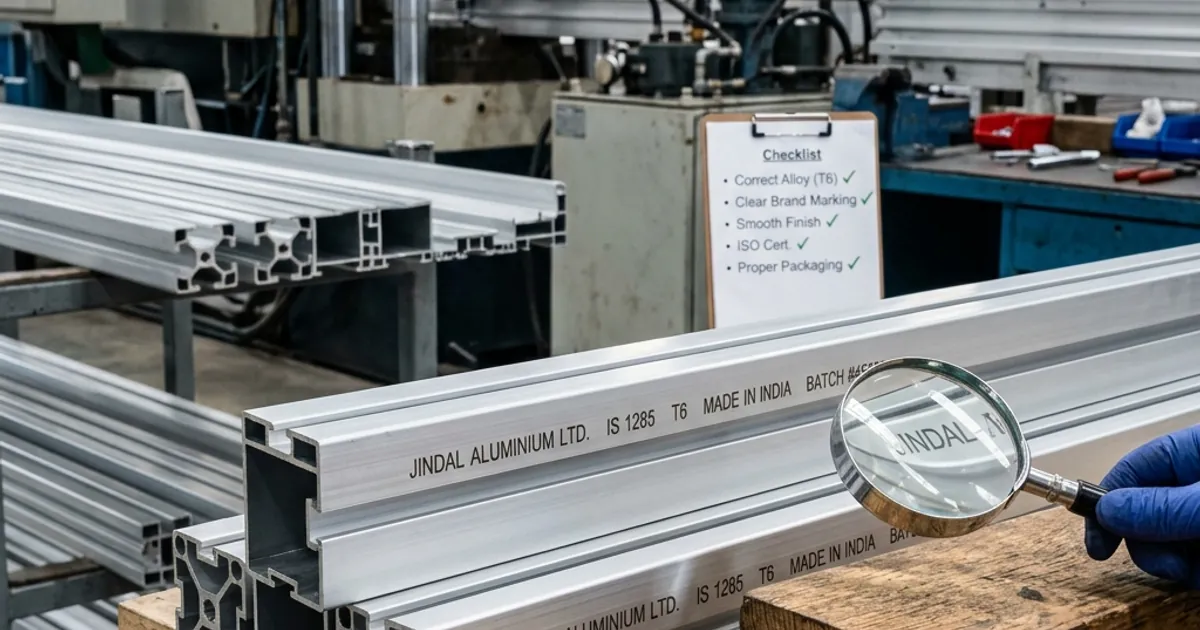
When you invest in construction, fabrication, architectural projects, or industrial manufacturing, the quality of your raw materials directly dictates the longevity, safety, and aesthetic appeal of the final structure. In the Indian subcontinent, the name Jindal Aluminium is virtually synonymous with unparalleled quality, engineering precision, and enduring durability. As the largest manufacturer of aluminium extruded profiles in India, their products form the backbone of millions of structures. However, this immense popularity and market dominance have also given rise to a sprawling, clandestine market of counterfeits and substandard imitations designed to deceive unsuspecting buyers.
The High Cost of Fake Aluminium Sections
Counterfeit aluminium sections might look identical to the naked eye. They are shiny, they come in the same shapes, and they are often pitched at a suspiciously attractive discount. But these fakes hide severe structural and chemical flaws that can spell disaster for your projects.
Fake profiles are typically extruded using recycled or scrap aluminium with improper, uncontrolled alloy compositions. Genuine architectural aluminium (such as the widely used 6063 or 6061 alloys) requires highly precise ratios of magnesium and silicon to achieve the necessary tensile strength and corrosion resistance. Scrap aluminium, melted down in unregulated foundries, contains impurities like excess iron, copper, or zinc, which drastically reduce the metal's performance.
Using these inferior sections can lead to catastrophic failures. Imagine a towering commercial building where the window frames warp under high wind pressure, causing glass to shatter. Consider architectural facades that corrode rapidly when exposed to urban pollution, completely ruining the aesthetic appeal within a few years. Think about load-bearing industrial structures buckling under weight because the metal lacked the proper temper. In short, saving a few rupees on counterfeit sections can end up costing you exponentially more in repairs, replacements, brand damage, and potential legal liabilities.
Understanding the Extrusion Process: Why Genuine Matters
To truly appreciate the difference between genuine and fake, one must understand the extrusion process. Jindal Aluminium utilizes state-of-the-art European extrusion presses. The process begins with homogenization, where aluminium billets are heated to ensure a uniform metallurgical structure. The billet is then pushed through a hardened steel die at immense pressures.
After extrusion, genuine profiles undergo a critical step called 'quenching' (rapid cooling), followed by 'artificial aging' in large ovens to achieve specific temper designations like T5 or T6. This heat treatment aligns the molecular structure of the magnesium-silicide precipitates, granting the aluminium its remarkable strength. Counterfeiters simply do not possess this multi-million dollar infrastructure. They skip homogenization, use worn-out dies, and completely bypass proper heat treatment, resulting in soft, brittle, and inconsistent metal.
The Ultimate Buyer’s Checklist for Genuine Jindal Aluminium
As a premier dealer in Delhi NCR, Imperial Metal Mart is committed to ensuring you receive exactly what you pay for. We have dealt with thousands of tons of aluminium and understand the nuances of authenticity. Here is our comprehensive, expert-approved checklist to help you identify 100% genuine Jindal Aluminium sections.
1. The Holy Grail: The Jindal Aluminium Branding and Logo
The most immediate and obvious indicator of authenticity is the branding present on the material itself. Jindal Aluminium employs sophisticated marking techniques that are difficult and expensive for counterfeiters to perfectly replicate.
- Laser Etching and Inkjet Printing: Genuine sections will feature clear, crisp, and continuous laser etching or high-resolution inkjet printing along the length of the profile. This printing typically includes the company name "Jindal Aluminium Ltd.", the specific alloy grade (e.g., 6063), the temper designation (e.g., T6), the standard conformity (like IS:1285), and a unique batch number. Check for smudging or fading; genuine printing is resilient.
- Polythene Protection Tape: For powder-coated, anodized, or wood-finish sections, genuine Jindal products come wrapped in a specific, branded protective film. The logo on this tape should be sharp, correctly proportioned, and clearly printed. More importantly, genuine tape is designed to protect the finish during transit and installation, but it peels off cleanly without leaving a stubborn, sticky adhesive residue behind.
- Holographic Stickers and Barcodes: On bulk bundles and larger architectural profiles, Jindal often utilizes tamper-evident holographic stickers. These holograms shift in color and design when viewed from different angles. Furthermore, modern bundles include scannable barcodes that trace the material back to its exact production batch.
2. Scrutinize the Surface Finish and Anodizing Quality
Jindal Aluminium operates some of the most advanced extrusion and surface finishing plants in the world. Their quality control is meticulous, meaning the physical appearance of the metal is a strong indicator of its origin. A visual inspection can reveal a lot about the quality of the die and the billet used.
- Flawless Surface (Mill Finish): Run your hand along the section. Genuine extrusions have a remarkably smooth finish. You should not feel any heavy die lines (longitudinal striations), pitting, blistering, or rough patches. Counterfeits often have visible, deep extrusion marks because counterfeiters use dies long past their prime to cut costs.
- Consistent Anodizing: If you are purchasing anodized sections (like the popular matte silver, champagne, bronze, or black), closely check the color consistency. The micron thickness of Jindal's anodizing is highly uniform across the entire length. Hold the section up to natural light; fake sections will show patchiness, uneven color tones, or a "rainbow" effect (iridescence) which indicates poor sealing during the chemical anodizing process.
- Powder Coating Adhesion and Texture: For powder-coated profiles, the finish should be perfectly even, without "orange peel" textures or embedded dust particles. Genuine powder coating undergoes a proper baking and curing process, ensuring immense adhesion. If you gently scrape a hidden, unexposed edge with a coin, authentic powder coating will resist chipping, whereas cheap, counterfeit coatings will flake off easily, exposing the raw metal beneath.
3. Weighing the Evidence: Section Weight and Dimensions
Aluminium is valued for its superior strength-to-weight ratio. Jindal adheres strictly to Indian Standards (IS) and international dimensional tolerances and theoretical weights. This is where counterfeiters make their money: by shortchanging the customer on material.
- Check the Micrometer Reading: Do not rely on visual estimates. Ask your dealer to measure the wall thickness with a calibrated micrometer or digital caliper at multiple points. A genuine Jindal section will match the catalog specifications perfectly (e.g., exactly 1.2mm, 1.5mm, or 2.0mm). Counterfeiters frequently "under-gauge" the material. They might supply 1.05mm when you paid for 1.2mm. Over a large project, this 0.15mm difference translates to hundreds of kilograms of missing aluminium and significantly weakened structures.
- Weight per Meter Validation: Every Jindal profile has a designated theoretical weight per meter (kg/m) listed in their official catalog. Weigh the entire bundle on a digital scale and divide by the total length in meters. If the actual weight is significantly lower than the theoretical weight (beyond the standard 5-7% manufacturing tolerance), you are absolutely dealing with under-gauged, fake material.
- Die Precision: Genuine sections fit together flawlessly. If you are buying interlocking sections (like sliding window tracks and stiles), slide them together. They should fit snugly without excessive play or binding. Poorly extruded fake profiles will struggle to interlock properly, leading to leaky, rattling windows.
4. Verify the Alloy Temper and Hardness
The "temper" designation (like T5 or T6) refers to the thermo-mechanical heat treatment process the aluminium has undergone to achieve its final yield strength and hardness. This is the invisible strength of the metal.
- Webster Hardness Tester: Professional fabricators and genuine dealers like Imperial Metal Mart use a Webster Hardness Tester. For a standard architectural 6063-T6 section, the hardness reading should reliably fall within a specific range (usually 10-14 Webster, or roughly 58-65 on the Brinell scale). If the metal tests significantly lower, it is "soft." It has not been properly heat-treated and will easily bend, dent, or fail under stress.
- The "Ring" Test (A Field Trick): While not highly scientific, experienced fabricators use this trick. Suspend a small off-cut of a genuine T6 tempered section and tap it with a steel tool, or drop it onto a hard concrete floor. It will produce a sharp, clear, high-pitched "ring," indicating dense, hardened molecular structure. Substandard or improperly tempered metal will yield a dull, flat "thud."
- Bend Test: A genuine T6 section is hard and will resist bending, eventually snapping if bent to an extreme angle due to its rigidity. Fake, soft metal will bend easily like a wire coat hanger without snapping.
5. The Ultimate Proof: Material Test Certificates (MTC)
You have the absolute right to demand proof of authenticity. In the metals industry, this comes in the form of a Material Test Certificate (MTC), sometimes called a Mill Test Report.
When you buy in bulk for a project, an authorized dealer will provide an MTC issued directly by Jindal Aluminium Ltd.'s quality control laboratory. This highly detailed document provides the scientific pedigree of your metal. It details the specific heat number, batch number, precise chemical composition (the exact percentage of Silicon, Iron, Copper, Manganese, Magnesium, Zinc, and Titanium), and the mechanical properties tested in the lab (Yield Strength, Ultimate Tensile Strength, and Elongation percentage).
Crucial Step: Ensure that the batch number printed on the MTC document exactly matches the batch number printed via inkjet on the physical aluminium sections you have received. If they do not match, the certificate is irrelevant to your material.
Deep Dive: Common Counterfeit Tactics to Watch Out For
Counterfeiters are becoming increasingly sophisticated. Here are some of the deceptive tactics used in the local markets that you must be vigilant against:
- The "Jindal-Sounding" Name: Unscrupulous sellers might sell you metal from a completely different, unbranded local factory but label it with names like "Jindal Gold," "Jindal Star," or "Jindal Super." These have absolutely no association with the original Jindal Aluminium Ltd. Always look for the exact corporate name.
- Bait and Switch Delivery: You might be shown genuine Jindal samples in the showroom, and the dealer might even weigh a genuine bundle for you. However, when the truck arrives at your construction site, the load is mixed with 70% fake sections hidden underneath a top layer of genuine profiles. Always inspect the material at the point of unloading.
- Fake Protective Tape: Counterfeiters easily print fake polythene tape with the Jindal logo and wrap it around inferior local metal. This is why you must rely on a combination of factors (weight, hardness, printing on the metal itself) rather than just the plastic wrapping.
- The "Tolerance" Excuse: When confronted with under-gauged material (e.g., measuring 1.0mm instead of 1.2mm), a dishonest dealer will claim it falls under "manufacturing tolerance." While standard tolerances exist, they are minimal (usually +/- 0.1mm depending on the profile size). A 0.2mm drop on a 1.2mm section is a massive 16% reduction in thickness and is a deliberate fraud, not a tolerance.
Why Buying from Authorized Dealers is Your Safest Bet
The most foolproof way to guarantee you are purchasing genuine Jindal Aluminium, avoiding all these traps and headaches, is to bypass the grey market entirely. Buying from an authorized, established stockist eliminates the guesswork and secures your investment.
Imperial Metal Mart has built its reputation over decades as a trusted pillar in the Delhi metal market by supplying only 100% authentic, factory-direct aluminium products. When you source your materials from us, you benefit from a completely transparent process:
- Direct Chain of Custody: We maintain direct supply lines from the Jindal Aluminium manufacturing plant straight to our warehouse. There are no middlemen where counterfeits can be introduced.
- Full Documentation & Compliance: Every transaction is accompanied by legitimate GST invoices, and original Material Test Certificates are provided with your project bulk purchases, ensuring audit compliance and peace of mind.
- Expert Engineering Consultation: Our experienced team does more than just sell metal. We help architects, engineers, and fabricators select the exact alloy, temper, and section profile optimized for their specific structural and aesthetic needs.
- Transparent, Calibrated Weighing: We utilize highly accurate, government-calibrated digital weighbridges and scales, ensuring you get exactly the weight you are billed for, down to the last kilogram.
- Massive Inventory: We stock thousands of standard dies and custom profiles in various finishes, ensuring your project doesn't face delays waiting for material.
Frequently Asked Questions (AEO Optimized)
How can I tell if aluminium is 6063 or 6061 visually?
Without a mass spectrometer, it is impossible to distinguish between 6063 and 6061 alloys visually. They look identical. You must rely entirely on the manufacturer's inkjet/laser printing on the extrusion itself and verify it against the accompanying Material Test Certificate (MTC). Generally, 6061 is a harder alloy used for structural, heavy-duty applications (like transportation or scaffolding), while 6063 provides a superior surface finish, making it the standard for architectural elements like windows, doors, and curtain walls.
Does genuine Jindal Aluminium rust or corrode?
Aluminium does not "rust" in the traditional sense because it contains virtually no iron. However, bare aluminium can oxidize when exposed to the elements, forming a white, powdery layer. Genuine Jindal sections are designed to prevent this through high-quality surface treatments. They are either chemically anodized or electrostatically powder-coated. These finishes provide a robust, impermeable protective layer against oxidation, UV degradation, and environmental corrosion, ensuring decades of durability even in harsh coastal or industrial environments.
What does 'T6' mean on Jindal aluminium sections?
'T6' indicates the specific temper or heat treatment the aluminium has undergone. Specifically, T6 means the alloy was first solution heat-treated (heated to a high temperature and rapidly quenched in water or air) and then artificially aged in an oven at a specific temperature for several hours. This metallurgical process forces magnesium and silicon to form precipitates, significantly increasing the structural yield strength and hardness of the aluminium, making it highly suitable for load-bearing and architectural applications where rigidity is paramount.
Is Jindal Aluminium more expensive than local brands?
Upfront, genuine Jindal Aluminium may command a slight premium per kilogram compared to unbranded, local, or counterfeit metal. However, this is not an "expense" but an investment in quality. Because Jindal provides accurate gauges (no under-gauging), correct alloys, and proper heat treatment, the structural integrity of your project is guaranteed. You save massive amounts of money in the long run by avoiding material failure, constant repairs, replacing faded/peeling finishes, and minimizing waste during fabrication. The lifetime value of genuine Jindal is significantly higher.
Protect Your Project Today
Don't compromise on the foundational materials of your project. Counterfeit aluminium is a serious risk to safety, structural longevity, and your professional reputation. Use this checklist rigorously, demand MTCs, verify gauges, and when in doubt, consult with certified experts rather than taking a gamble on the grey market.
Looking for guaranteed authentic, factory-fresh Jindal Aluminium sections in Delhi NCR? Contact Imperial Metal Mart today for competitive wholesale pricing, expert guidance, and absolutely uncompromising quality.