

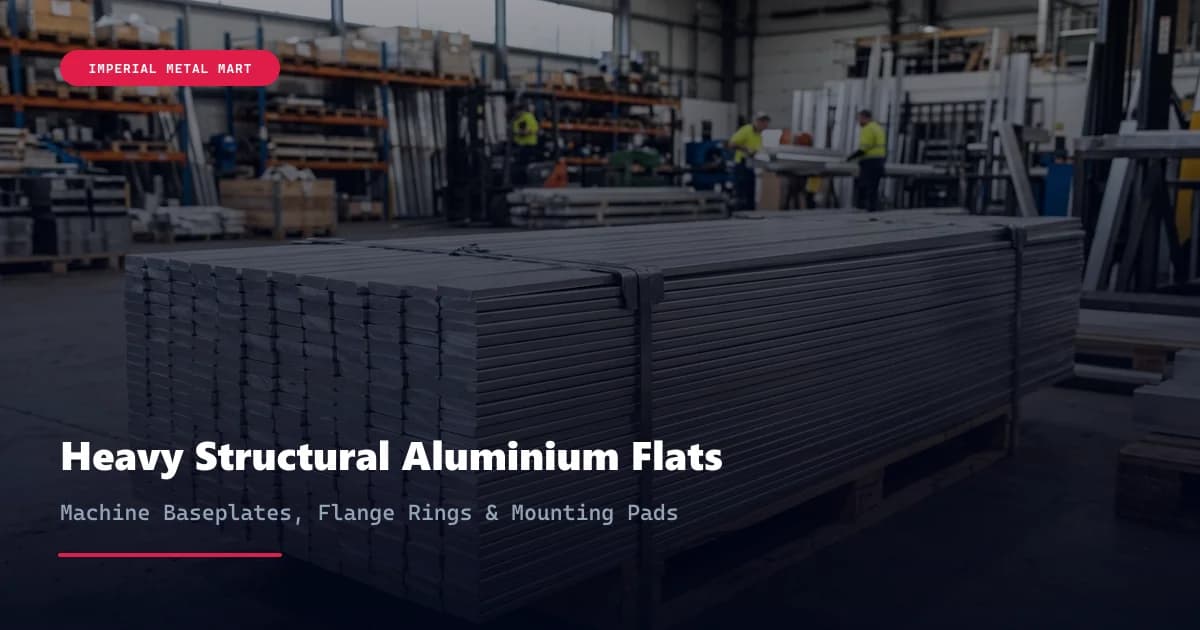
In precision machine tool building, automated assembly fixtures, pump skid fabrication, and robotic baseplate construction, structural base elements must provide exceptional dimensional flatness, high rigidity, and clean machinability.
When fabrication shops fabricate base pads by gas-cutting or waterjet-cutting standard rolled commercial plates, they frequently encounter severe challenges: plate cutting introduces internal residual stress causing parts to bow during CNC milling, edge bevels require heavy cleanup, and plate thickness varies widely across the sheet.
To bypass these costly machining bottlenecks, precision toolmakers specify heavy extruded aluminium flats—extruded solid rectangular bars engineered with true 90-degree square corners, uniform parallel faces, and exceptional dimensional stability.
Extruded Aluminium Flats vs Cut Plate: 4 Mechanical Differences
1. Precision Square Edges
Extruded structural flats feature crisp, parallel square edges right out of the extrusion die.
Primary Advantage: Requires minimal edge squaring or face skim milling, saving hours of costly machine cycle time on vertical machining centers (VMCs).
2. Low Residual Stress
Extruded profiles undergo controlled factory stretching and artificial aging.
Primary Advantage: When deep pocketing, slot milling, or drilling dense hole arrays, extruded flats remain dimensionally stable and flat without potato-chipping.
3. Superior Thread Shear Strength
Thick extruded flats (10mm to 25mm gauge) provide deep full-depth metric thread engagement.
Primary Advantage: Permits direct tapping of M8, M10, and M12 bolt threads that withstand heavy cyclic pull-out loads under operating hydraulic or servo pressures.
4. Uniform Hardness & Density
Extruded from primary virgin aluminum billets with strict die pressure consolidation.
Primary Advantage: Completely free of internal gas voids, micro-porosity, or rolling laminations that cause carbide drill breakage during high-speed CNC drilling.
Heavy Structural Aluminium Flats Sizing Matrix
Below is a dimensional specification table for heavy-gauge solid extruded aluminium flats available from Imperial Metal Mart:
| Bar Width (mm) | Standard Thickness (mm) | Standard Length | Edge Profile | Recommended Engineering Use |
|---|---|---|---|---|
| 50.0 mm | 10.0 mm / 12.0 mm | 3.66m (12ft) | Square Edge | Conveyor side wear rails, linear bearing support pads, sensor mounting brackets |
| 75.0 mm | 12.0 mm / 16.0 mm | 3.66m (12ft) | Square Edge | Pneumatic manifold mounting plates, structural gusset plates, tooling risers |
| 100.0 mm | 12.0 mm / 16.0 mm / 20.0 mm | 3.66m (12ft) | Square Edge | Machine foot mounting pads, motor slide baseplates, robotic arm adapter plates |
| 150.0 mm | 16.0 mm / 20.0 mm / 25.0 mm | 3.66m (12ft) | Square Edge | Heavy equipment base skids, circular flange rings, pump base leveling plates |
| 200.0 mm | 20.0 mm / 25.0 mm | 3.66m (12ft) | Square Edge | Large VMC vacuum fixture beds, indexing rotary table sub-plates, press bolsters |
Machining, Drilling & Tapping Guidelines
Thread Engagement Depth Rule
When threading high-tensile steel metric fasteners into structural aluminium flats, always design for a minimum thread engagement depth of 1.5× to 2.0× the nominal bolt diameter (e.g., 15mm to 20mm thread depth for an M10 bolt). This guarantees that the steel bolt will break before aluminum threads strip under extreme tensile overload.
High-Speed CNC Milling Speeds
Extruded flats machine cleanly at high cutting speeds (800 to 1,500 m/min) using polished 2-flute or 3-flute solid carbide end mills with high rake angles, producing mirror-smooth surface finishes with minimal burr formation.
Edge Chamfering & Deburring
While square edges provide precision locating datum surfaces, applying a 0.5mm 45-degree corner break or chamfer protects technicians' hands and prevents stress riser fractures on sharp outside corners.
Frequently Asked Questions
What is the difference between electrical busbar flats and structural aluminium flats?
Electrical busbars are manufactured with rounded radius edges and high electrical conductivity properties tailored for switchgear current flow. Structural mechanical flats are extruded with crisp, sharp square 90-degree edges, flat parallel reference planes, and higher mechanical stiffness engineered for machine mounting and precision CNC milling.
Are Mill Test Certificates (MTC) provided with heavy flats?
Yes. Every industrial order from Imperial Metal Mart can be accompanied by authentic manufacturer Mill Test Certificates verifying strict dimensional compliance, mechanical hardness, and prime virgin billet extrusion traceability.
Can Imperial Metal Mart supply cut pieces of thick aluminium flats in Delhi?
Yes. In addition to full standard 3.66-meter (12-foot) stock bars, we provide precision band-saw cutting services at our Paharganj, New Delhi stockyard, supplying custom cut billets and baseplate blocks directly to toolmakers across Delhi NCR.
Source Heavy Structural Aluminium Flats in Delhi
Imperial Metal Mart supplies precision toolmakers, machine shops, and fabrication facilities with heavy extruded Jindal aluminium industrial flats, busbars, and square bars.