

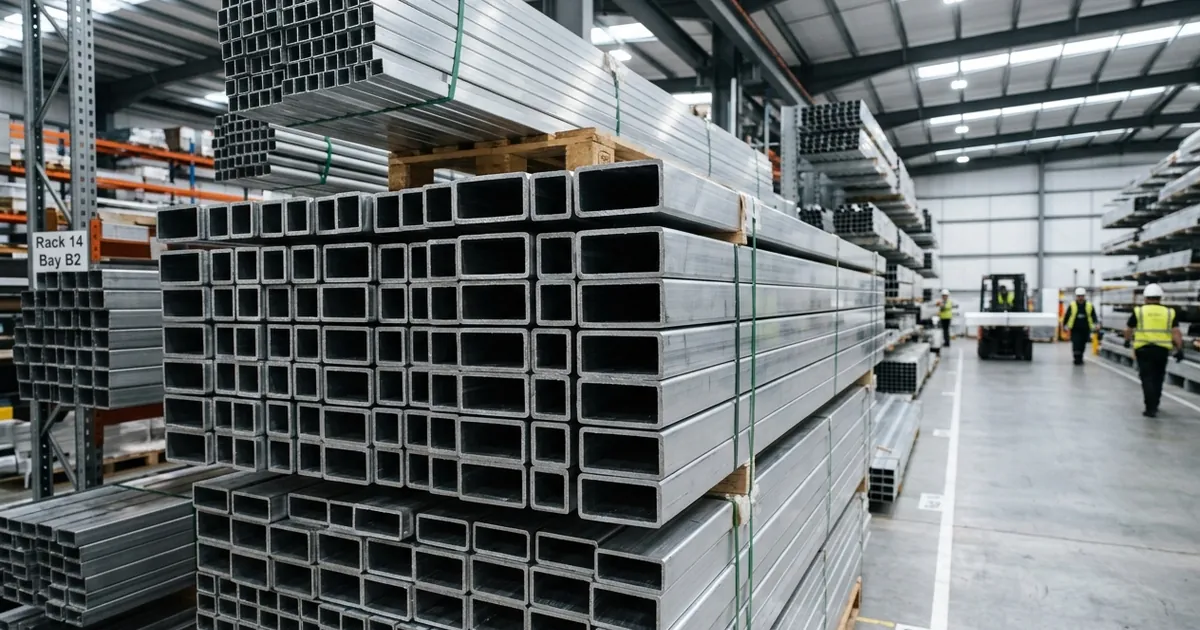
In the aluminium fabrication and construction industry, aluminium is universally traded and billed by weight (kilograms), yet architectural drawings, window schedules, and floor layouts are dimensioned in running feet or meters.
Bridging this gap requires an exact understanding of theoretical weight calculation. Whether you are an estimator preparing a multi-crore tender, a fabricator calculating your cutting list, or a site engineer verifying incoming material on a digital weighbridge, knowing how to utilize the Jindal Aluminium section weight chart and universal mathematical formulas is essential to preventing project cost overruns and avoiding fraudulent under-gauging.
The Metallurgical Science of Aluminium Density
All theoretical weight calculations begin with the physical constant of aluminium's specific mass density. Virgin commercial extrusion alloys (principally 6063 and 6061) have an industry-standard density of:
Because steel has a density of approximately 7.85 g/cm³, aluminium weighs roughly one-third (34.4%) the mass of equivalent steel sections. To convert this physical density into rapid workshop calculations, engineers use simplified multiplier coefficients.
Universal Aluminium Weight Calculation Formulas
When you have geometric dimensions (all in millimeters) and standard extrusion profiles, use the following formulas to calculate theoretical weight in kilograms per meter (kg/m):
1. Solid Aluminium Flat Bar
Example: A 50mm wide × 6mm thick flat bar: 50 × 6 × 0.0027 = 0.81 kg/m (or 0.247 kg/ft).
2. Aluminium Round Pipe / Tube
Example: A 50.8mm (2") OD round pipe with 2.0mm wall thickness: (50.8 - 2.0) × 2.0 × 0.008482 = 0.828 kg/m.
3. Square / Rectangular Hollow Tube Section
Example: A 50mm × 25mm rectangular tube with 1.5mm wall: [2×(50+25) - 4×1.5] × 1.5 × 0.0027 = [150 - 6] × 1.5 × 0.0027 = 0.583 kg/m.
4. Equal / Unequal L-Angle
Example: A 25mm × 25mm angle with 3mm thickness: (25 + 25 - 3) × 3 × 0.0027 = 47 × 3 × 0.0027 = 0.381 kg/m.
Master Reference Chart: Common Architectural Sections
Below is a benchmark reference table listing standard theoretical weights for popular architectural profiles sourced from the official Jindal Aluminium Catalogue:
| Profile Description | Typical Die Dim. (mm) | Gauge (mm) | Weight (kg / meter) | Weight (kg / 12ft piece) |
|---|---|---|---|---|
| 2-Track Sliding Window Bottom Frame | 62.0 × 32.0 | 1.20 | 0.680 kg/m | 2.49 kg |
| 3-Track Sliding Window Bottom Frame | 92.0 × 32.0 | 1.30 | 0.995 kg/m | 3.64 kg |
| Sliding Window Shutter (Bearing / Handle) | 40.0 × 18.0 | 1.20 | 0.425 kg/m | 1.55 kg |
| Interlock Section (Sliding Center Joint) | 40.0 × 26.5 | 1.15 | 0.440 kg/m | 1.61 kg |
| Partition Framework (2.5" × 1.5") | 63.5 × 38.1 | 1.50 | 0.890 kg/m | 3.26 kg |
| Square Tube (1" × 1") | 25.4 × 25.4 | 1.20 | 0.315 kg/m | 1.15 kg |
| Heavy Domal Sliding Track Profile | 108.0 × 45.0 | 1.80 | 1.840 kg/m | 6.73 kg |
| Curtain Wall Mullion Profile | 120.0 × 50.0 | 2.50 | 2.980 kg/m | 10.90 kg |
Understanding IS 3965 Dimensional & Weight Tolerances
In industrial manufacturing, it is physically impossible to produce every meter of metal with zero variation due to gradual die wear and thermal contraction. The Bureau of Indian Standards (BIS) defines permissible manufacturing tolerances under standard IS 3965 (Extruded Aluminium Sections):
- Weight Tolerance: For standard architectural hollow profiles, permissible deviation between actual weight and theoretical catalogue weight is generally within ±5% to ±7%.
- Wall Thickness Tolerance: Typical wall thickness variation allowed is ±0.10mm to ±0.15mm depending on the profile width.
- The Under-Gauging Red Flag: If a bundle of 1.20mm window section weighs 15% to 25% lower than the official Jindal weight chart, this is not a manufacturing tolerance—it is a deliberate fraudulent under-gauge supply by an unauthorized vendor.
Frequently Asked Questions
How many feet are in a standard Jindal section?
Standard Jindal aluminium sections are typically manufactured and stocked in standard lengths of 12 feet (3.66 meters), 14.5 feet (4.42 meters), 15 feet (4.57 meters), and 20 feet (6.10 meters). 12-foot lengths are the most common for residential door and window framing.
Does powder coating or anodizing add weight to the section?
Anodizing converts the existing surface metal into aluminium oxide and adds negligible weight (less than 0.05%). High-grade powder coating adds a polyester polymer film of 60 to 80 microns, increasing the physical weight of the section by approximately 15 to 35 grams per square meter of surface area (approx. 1% to 2% of total weight).
Where can I find official Jindal Aluminium die numbers and weights?
You can download the comprehensive, official PDF catalog with over 5,000 active dies and their exact theoretical weights (kg/m) directly from our Jindal Aluminium Catalogue download page.
Need Project Material Estimations or Quotations?
Imperial Metal Mart provides precision material takeoff estimates for architectural drawings. Send us your window schedules or BOQ, and our senior estimators will provide certified weight calculations and transparent wholesale billing.