

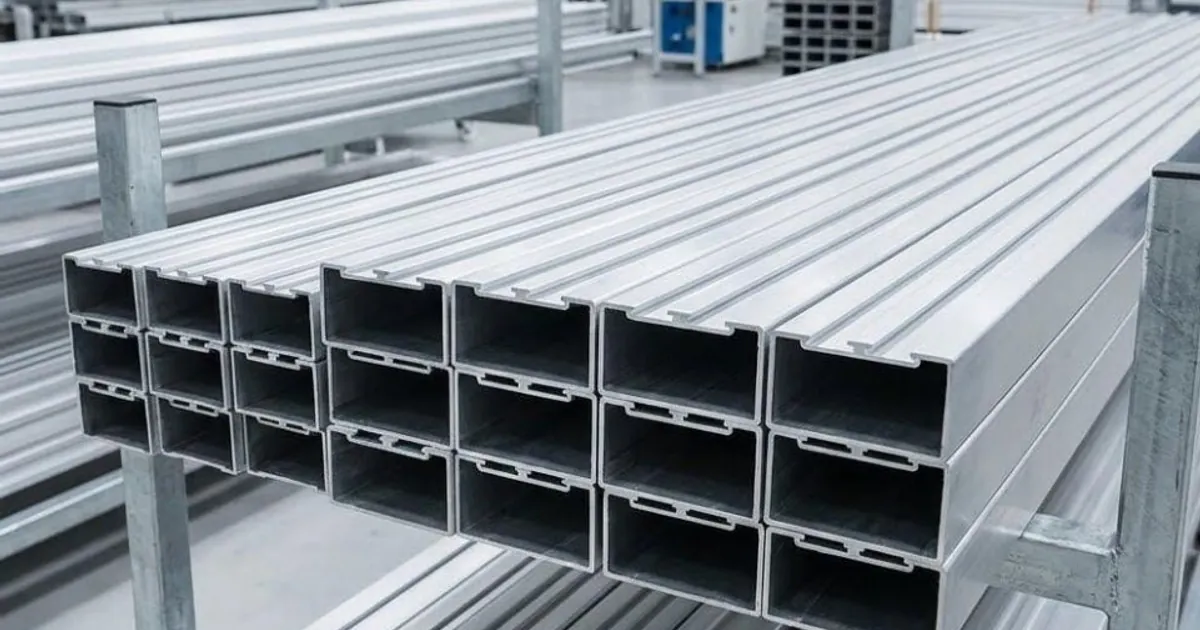
When architects, structural engineers, or fenestration fabricators open the official Jindal Aluminium Section Catalogue, they are presented with hundreds of pages featuring thousands of engineering profile drawings, dimensional callouts, and numeric die codes.
To newcomers, deciphering 4-digit and 5-digit section numbers, reading cross-sectional millimeter callouts, and differentiating between architectural and industrial geometries can seem daunting. Yet, the Jindal catalogue is organized with engineering precision.
Mastering how to navigate this document enables fabricators to accurately quote projects, eliminate on-site fitting errors, prevent costly ordering mistakes, and request exact dies from authorised stockists like Imperial Metal Mart in Delhi NCR.
Need the Official Jindal Catalogue PDF?
Download the complete technical catalogue with all architectural and industrial profiles.
The Anatomy of a Jindal Catalogue Entry
Every page in the Jindal Aluminium Catalogue displays multiple extruded profile blocks. Each block contains five standardized technical elements:
Section / Die Number (e.g., Sec. 1012, Sec. 3254)
This is the unique master tooling number assigned to that exact die by Jindal Aluminium. When ordering from stockists or distributors, quoting this number guarantees you receive the precise die silhouette, snap-fit grooves, screw bosses, and wall profile.
2D CAD Cross-Section Drawing
A true-to-scale transverse cross-section illustrating the geometry of the profile. It reveals whether the section is a solid bar, semi-hollow channel, or fully enclosed multi-chamber hollow box, along with internal screw ports, weatherstrip gasket tracks, and interlocking tongue-and-groove joints.
Dimension Callouts (Width × Height × Thickness in mm)
Detailed engineering callouts in millimeters (mm):
- A & B: External primary dimensions (e.g., Width × Height or Outer Diameter).
- T or t: Nominal wall thickness of the outer webs and internal ribs.
- R or r: Fillet or corner radii, showing whether edges are crisp 90-degree square corners or radiused stress-relief curves.
Perimeter / Girth Measurement
The total outer exposed surface perimeter measured in millimeters. This metric is used by powder coating applicators and anodizing plants to calculate surface area for chemical pre-treatment and electro-deposition coating pricing.
Category Classification Group
Indicates the functional engineering family: Architectural (windows, doors, curtain walls), Structural (angles, channels, beams), Industrial (tubes, rods, flats, busbars), or Transport (commercial vehicle bodies, flooring, cant rails).
Key Catalogue Categories & Section Numbering System
Jindal categorizes extrusions by application families. Understanding these sections makes finding any profile quick and straightforward:
1. Architectural Windows & Doors
Includes 2-track, 3-track, and 4-track sliding window bottom rails, top guides, shutter verticals, interlocking stiles, and openable casement door frames.
Die Series: 1000 to 3500 series
2. Domal European Series
Premium European-style architectural sections for high-end residential and villa sliding doors, casements, and tilt-and-turn windows.
Die Series: Domal 27mm, 35mm, 40mm series
3. Commercial Partition Frameworks
Modular office cabin sections such as 63.5 × 38.1 mm (2.5" × 1.5") and 44.5 × 44.5 mm (1.75" × 1.75") with snap-on glazing beads.
Die Series: Partition & Glazing profiles
4. Industrial Tubes, Pipes & Boxes
Round seamless and extruded pipes, square hollow sections, and rectangular box sections for machine guards, furniture, and structural frames.
Die Series: Round, Square & Rectangular Tubes
5. Solid Industrial Flats, Rods & Busbars
Solid rectangular flats, round CNC turning rods, hexagonal bars, and high-conductivity electrical busbar strips.
Die Series: Solid Flats, Rods & Busbars
6. Curtain Wall & Facade Profiles
Structural vertical mullions, horizontal transoms, pressure plates, and cover caps designed to bear intense exterior wind pressures on high-rise towers.
Die Series: Curtain Wall 50mm & 60mm series
Standard Catalogue Dimensions & Application Reference
Below is a representative dimensional overview of popular Jindal section categories available through stockists in Delhi NCR:
| Catalogue Category | Typical Section Group | Standard Cross-Section Dimensions (mm) | Standard Wall Gauges (mm) | Primary Industrial Application |
|---|---|---|---|---|
| Equal L-Angles | Structural Angles | 19.0 × 19.0 to 100.0 × 100.0 mm | 1.20 to 6.00 mm | Solar racks, architectural corners, framework gussets |
| Square Hollow Box | Hollow Tubes | 19.0 × 19.0 to 100.0 × 100.0 mm | 1.20 to 3.20 mm | Cleanroom frameworks, machine guards, handrails |
| Rectangular Tube | Hollow Tubes | 38.0 × 25.0 to 150.0 × 50.0 mm | 1.50 to 3.00 mm | Pergolas, architectural louvers, structural posts |
| Office Partition | Interior Partitions | 63.5 × 38.1 mm (2.5" × 1.5") | 1.20 to 2.00 mm | Commercial office cabins, meeting room glass walls |
| 3-Track Window Rail | Architectural Fenestration | 92.0 mm Outer Track Width | 1.20 to 1.60 mm | Residential sliding windows with mosquito mesh track |
| Industrial Flat Bar | Solid Industrial Flats | 25.0 × 3.0 to 150.0 × 12.0 mm | Solid (3.0 to 12.0 mm) | Electrical control panels, busway trunking, machinery base |
| Curtain Wall Mullion | Facade System | 50.0 × 100.0 to 60.0 × 150.0 mm | 2.50 to 4.00 mm | High-rise structural glass facade vertical supports |
How to Read Dimension Symbols in Section Drawings
When examining section drawings inside the catalogue, keep these universal conventions in mind:
- Outer Dimensions vs Inner Dimensions: Outer boundaries are always prioritized in catalogue callouts because they define frame fitment inside rough wall openings. Internal chamber dimensions define glass pocket depth and glazing gasket clearance.
- Web vs Flange Thickness: In open sections like U-channels and L-angles, the horizontal base is designated as the web, and the vertical legs are flanges. In heavy-duty architectural profiles, the web thickness may be thicker than the flanges to handle screw holding forces.
- Corner Fillets & Radii (R): Fillet radii rounded inside internal corners prevent stress concentration and profile cracking under mechanical bending or wind vibration.
- Dimensional Tolerances: All Jindal Aluminium extrusions conform to Indian Standards (IS:3965 / IS:2673) for dimensional, angularity, straightness, and twist tolerances, ensuring straight lengths for smooth mitering.
Specifying Surface Finishes in Jindal Orders
Extruded aluminium leaves the die in raw silver form. Depending on your project requirements, specify one of three standard surface treatments:
1. Mill Finish
Natural silvery finish straight off the extrusion press. Ideal for concealed internal frameworks, CNC machining, or workshops planning in-house powder coating.
2. Anodized Finish
Electro-chemically grown protective aluminium oxide layer (15 to 25 microns). Available in Natural Matt Silver, Champagne, Bronze, and Deep Black. Extremely scratch and corrosion resistant.
3. Powder Coated
Thermoset polyester architectural powder coating (60 to 80 microns). Available in any standard RAL shade (e.g., Pure White RAL 9016, Anthracite Grey RAL 7016, Charcoal, or Wood Grain).
Checklist: How to Place an Error-Free Wholesale Order
To obtain fast quotations and prompt dispatch from Imperial Metal Mart, include these 5 critical details with your request:
1. Exact Jindal Section / Die Number
Specify the 4-digit or 5-digit die code (or attach a CAD cross-section drawing / photo of the sample).
2. Wall Thickness & Dimensions
Specify the outer dimensions (mm) and required wall thickness gauge (e.g., 1.50 mm or 2.00 mm).
3. Profile Length
Standard lengths are 3.66m (12 ft), 4.88m (16 ft), or custom lengths for large architectural projects.
4. Required Surface Treatment
Specify Mill Finish, Natural Anodized (15-25μ), or Powder Coated with the desired RAL shade.
5. Order Quantity
Indicate the number of standard lengths or total project kilograms for bulk pricing.
Frequently Asked Questions
How do I match an existing aluminium section if I don't know the die number?
Cut a small 2-inch clean cross-sectional slice of your physical profile and bring it to Imperial Metal Mart in Paharganj, New Delhi, or send a calibrated digital photo with vernier calliper measurements of Width, Height, and Thickness. Our technical team can cross-reference it against our die index in minutes.
Does the section number change when ordering powder-coated or anodized finishes?
No. The Jindal section die number identifies the extruded geometric shape and tooling die. When ordering, the die number stays identical (e.g., Sec. 1012), and surface finish codes (such as MF for Mill Finish, NA for Natural Anodized, or PC with RAL number for Powder Coated) are added to the line item.
Where can I download the complete Jindal Aluminium Section Catalogue?
You can download the verified, comprehensive Jindal Aluminium Section Catalogue directly from our dedicated resource page at /jindal-aluminium-catalogue.
Can Imperial Metal Mart supply customized or non-standard Jindal sections in Delhi NCR?
Yes. In addition to our extensive ready inventory of standard Jindal architectural, hollow, and solid sections in Delhi, we facilitate mill-direct custom die development and high-volume extrusion runs for large facade contractors and OEMs.
Source Genuine Jindal Aluminium Sections in Delhi NCR
Imperial Metal Mart is your trusted wholesale distributor for Jindal Aluminium extrusions, architectural profiles, industrial tubes, and solid flats in Delhi NCR. Get fast quotations and reliable stock availability.