

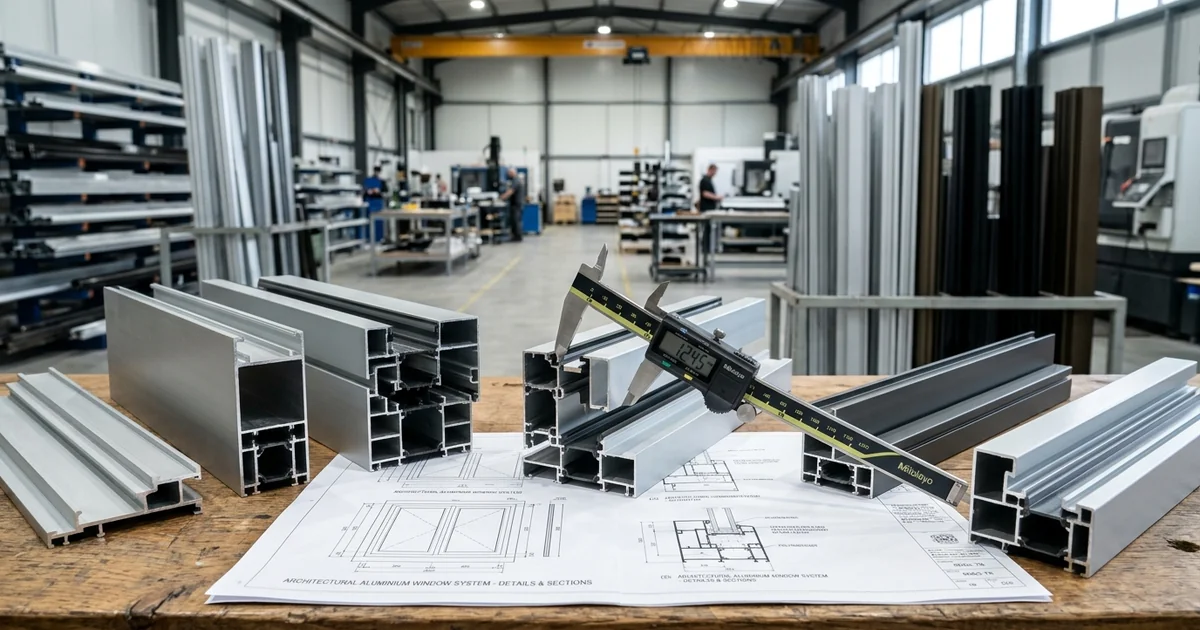
Before placing your first aluminium extrusion order, six technical choices must be crystal clear: the exact section number, alloy and temper, surface finish, wall thickness, bar length, and cutting quantity. Once these are defined, verifying dealer credentials and executing a disciplined delivery inspection saves your workshop thousands of rupees in rework.
The 12-Point Fabricator Checklist
Print this or check it off on screen before calling any aluminium supplier.
Step by Step: What to Decide Before You Order
1Fix the Section Number for Every Profile
Aluminium sections are sold by die or section number, not by colloquial names alone. Describing a profile simply as a "sliding window bottom rail" can refer to dozens of completely different dies across various window series.
Always extract the precise section numbers from the manufacturer's technical manual or from the shop drawing of the window, door, or partition you intend to fabricate. If you work from the Jindal Aluminium Catalogue, it provides exact die numbers, perimeter dimensions, and nominal weight per metre for our complete window & door sections and partition profiles. Fabricating for high-rise or dust-prone urban apartments? Follow our specialized guide on Aluminium Window Sections for Dusty, Windy and High-Rise Delhi Homes.
2Confirm Alloy and Temper
Alloy chemistry dictates structural strength, corrosion defense, and surface anodizing quality. The temper designation (such as T5 or T6) specifies the artificial heat treatment applied after extrusion.
For architectural windows, doors, interior partitions, and general shopfronts, 6063-T6 is the universal industry standard. For structural frameworks, mobile scaffolding, machine tooling fixtures, and transport skids, fabricators specify stronger alloys like 6061-T6 or 6082-T6. For a complete metallurgical and mechanical breakdown, read our in-depth 6063 vs 6061 Aluminium Alloy Comparison Guide. Insist that your supplier writes the exact alloy and temper on the quote, rather than vague labels like "commercial aluminium".
3Choose the Finish
The surface finish dictates both exterior aesthetics and outdoor weather durability:
- • Mill finish:Raw extruded aluminium straight from the extrusion press; the most economical option, suited for parts you plan to powder-coat in-house or conceal inside framing.
- • Anodized finish:A thin, ultra-hard electro-chemical oxide layer (typically 15 to 25 microns) available in natural silver, champagne, bronze, and matte black tones; highly scratch-resistant for windows.
- • Powder coated finish:An electrostatically applied thermoset polyester layer (60 to 80 microns) offering virtually unlimited RAL color selections, matte architectural textures, and realistic wood-grain sublimation.
Review our detailed guide on Anodized vs. Powder Coated Aluminium Sections before choosing. Always order all sections for one project from the same production lot, as subtle shade variances can occur between separate coating batches.
4Note Wall Thickness and Weight Per Metre
Two extrusions with identical exterior silhouettes can differ dramatically in their interior wall gauge—and consequently in structural rigidity, deflection limits, and weight. Always verify the nominal wall thickness and weight per metre against official catalogue values.
Theoretical Weight Formula:
Weight (kg/metre) = Cross-sectional area (mm²) × 0.0027
Example: An extrusion with 250 mm² of solid metal area weighs approximately 0.675 kg per metre, meaning a standard 12 ft (3.66 m) bar weighs roughly 2.47 kg.
For step-by-step cross-sectional calculation methods and tolerance checks, consult our Jindal Aluminium Section Weight Chart & Calculation Guide.
5Settle Bar Length and Plan Your Cuts
Aluminium profiles are generally supplied in full mill lengths. While 12 ft (3.66 m) is the most common stock length for architectural fenestration, 16 ft (4.88 m) bars are also stocked for taller curtain walls and industrial box tubes.
Prepare an optimized linear cut plan prior to placing the order. Group horizontal and vertical dimensions to maximize bar yield so remaining offcuts are short and manageable. Inquire whether your distributor offers precision cut-to-length band-saw services to reduce workshop scrap.
6Work Out Quantity, with Wastage
Calculate the total linear footage required for every piece on your fabrication cut list, divide by the usable bar length, and round up to the nearest full bar.
Always factor in a 5% to 8% wastage allowance for saw kerf blade cuts, 45-degree miter trimmings, clamping margins, and novice cutting mistakes. Ordering extra bars is especially critical for powder-coated or anodized profiles, as matching an exact color shade on a delayed top-up order can be difficult.
7Match the Accessories to the Series
Extruded aluminium sections function as an integrated architectural system. They perform reliably only when paired with correct co-extruded EPDM gaskets, wool piles, nylon or steel ball-bearing rollers, die-cast internal corner cleats, multi-point lock bodies, and snap-on glass beadings designed for that exact die groove.
Confirm that every hardware accessory aligns with your chosen section numbers, and purchase them simultaneously so your fabrication team receives a complete, plug-and-play installation suite.
Choosing a Supplier You Can Trust
Price per kilogram is an important factor, but buying cheap under-gauged profiles extruded from recycled scrap metal results in far higher total costs once sections crack during fabrication, bow under wind loads, or fail client handover inspections. Always verify the credibility of the supplier before evaluating the quotation.
Check Authorisation and Paperwork
Authorisation Certificate: When a stockist claims to be an authorized dealer of Jindal Aluminium Ltd., request to see their official dealership certificate. Check out our Authorised Jindal Aluminium Dealer Credentials to understand verification standards.
GST Tax Invoice:Never accept unrecorded cash slips. Purchase strictly against an authentic GST tax invoice featuring the distributor's registered legal entity, HSN codes, and active GSTIN.
Mill Test Certificate (MTC): For structural projects, electrical busbars, or government tenders, verify that original factory test certificates showing batch mechanical hardness and alloy conformance are available.
Computerized Brand Markings: Genuine sections from primary extruders carry computerized ink-jet or stamped brand markings along profile faces. Learn how to spot counterfeit stamping in our guide on How to Identify Genuine Jindal Aluminium Sections.
7 Questions to Ask Before You Order
Get the Quote in Writing
A professional commercial quote should explicitly detail: die section numbers, confirmed alloy/temper, finish and micron specification, bar length, quantity of bars, unit rate and pricing basis (per kg or per piece), GST rate, and estimated delivery timeline. A written quote enables fair side-by-side comparison between suppliers and provides indisputable legal proof if delivery discrepancies arise.
Source Genuine Jindal Aluminium Sections Since 1972
For fabricators across Delhi NCR, Haryana, and Western UP, Imperial Metal Mart has served as an exclusive authorised stockist of Jindal Aluminium for over 50 years. Visit our central warehouse at 8750, Desh Bandhu Gupta Road, Paharganj, New Delhi, or reach our technical desk for prompt wholesale quotations.
Delivery Day: Inspect Before You Sign
Execute a structured physical inspection while the delivery vehicle is still parked at your facility. Discrepancies noted after the driver departs are significantly harder to claim.
1Count Bundles & Sections
Tally the number of bundles and individual bars against the delivery challan and invoice. Verify that die number tags on bundles match your order.
2Verify Bar Lengths
Pull a steel measuring tape across several random bars. Under-length bars will ruin your pre-calculated cut plan.
3Inspect Surface Quality in Good Light
Check anodized and powder-coated sections under daylight for transit scratches, denting, chemical stains, or color banding.
4Check Profile Straightness
Sight down the longitudinal axis of several bars or roll them on a flat concrete surface. Bowed or twisted bars lead to misaligned window frames.
5Measure Wall Thickness with Calipers
Use a digital vernier caliper on sample pieces to verify that profile gauges match catalogue standards without under-gauging.
6Verify Alloy & Temper Stamps
Confirm that factory die marks and temper stamps correspond with your invoice and promised Mill Test Certificates.
7Record Faults on the Delivery Challan
Take high-resolution photos and clearly annotate any damaged or missing bundles on both copies of the delivery slip before signing.
Store Sections Properly in Your Workshop
Improper storage can ruin pristine extrusions before fabrication even begins:
- Store Horizontally on Level Supports: Lay bars flat on wooden battens spaced every 1.5 to 2.0 metres. Never lean bars vertically against workshop walls, as continuous slanting introduces permanent sag.
- Keep Protective Film Intact: Leave factory masking film and kraft paper wrapping on profiles until cutting and assembly to shield surfaces from flying metal swarf.
- Isolate from Wet Cement & Acids: Alkaline substances such as wet cement, mortar, lime plaster, and muriatic cleaning acids permanently corrode and stain aluminium finishes within hours.
- Avoid Over-Stacking Finished Profiles: Never stack heavy structural channels or solid steel bars on top of delicate anodized or powder-coated window extrusions.
Frequently Asked Questions for First-Time Buyers
Which aluminium alloy is best for windows and doors?
6063-T6 is the usual choice for windows, doors and partitions because it extrudes cleanly, takes anodizing and coating well, and has enough strength for architectural framing. Use 6061 or 6082 where the part carries heavier structural loads.
How do I calculate the weight of an aluminium section?
Multiply the cross-sectional area in mm² by 0.0027 to get kg per metre, then multiply by the length in metres. The official Jindal catalogue usually gives the theoretical weight per metre directly, so use that whenever available.
Is aluminium sold per kg or per piece?
Both pricing methods are used. Extruded sections are often priced per kg, which makes weight per metre and wall thickness essential to track; accessories, such as corner cleats and rollers, are priced per piece. Always confirm the pricing basis on your written quote.
What length do aluminium sections come in?
Many architectural profiles are supplied in standard 12 ft (3.66 m) bars, though 16 ft (4.88 m) and custom extrusions exist. Confirm the exact stock length for each section before calculating your cut plan and wastage.
Should I choose anodized or powder coated sections?
Anodized sections provide a hard, integral metallic surface in natural silver, bronze and black tones. Powder coating offers a thicker painted protective layer with a vast range of RAL shades and wood-grain finishes. Match the choice to your architectural aesthetic, outdoor exposure and budget.
How can I tell whether a section is genuine?
Check the dealer’s official authorisation certificate, verify computerized brand markings stamped along the profile wall, compare physical weight per metre with catalogue standards, and insist on a manufacturer Mill Test Certificate (MTC). Sections that weigh noticeably less than the catalogue figure are likely under-gauged.
Can a new fabricator buy small quantities?
Yes. Authorised stockists like Imperial Metal Mart cater to both small starter workshop orders and multi-ton commercial project schedules. Inquire about minimum order quantities (MOQ) and cutting services before finalizing your order.
Ready to Place Your First Aluminium Order?
Imperial Metal Mart helps first-time fabricators choose the right Jindal section numbers, calculate cut plans, and receive 100% genuine extrusions with full GST invoices and Mill Test Certificates.