

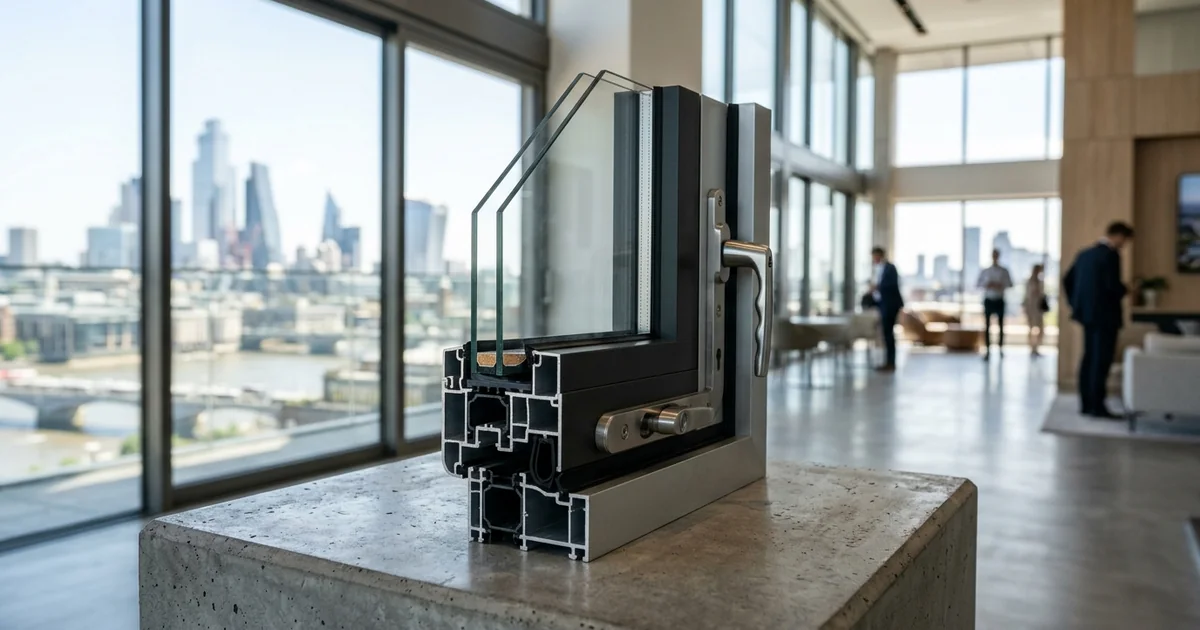
Delhi Urban Fenestration Core Rule
Delhi NCR presents an aggressive microclimate: heavy airborne PM 2.5 and road dust, violent pre-monsoon dust storms (andhi), intense summer solar radiation (45°C+), concentrated monsoon cloudbursts, and high wind pressures on 10th to 35th floor high-rises. Success requires matching section wall thickness, gasket compression, drainage design, and surface finish to your specific floor level and orientation.
What Delhi conditions ask of a window
A window in Delhi faces fine dust through most of the year, strong gusts on upper floors, hot summers, a short monsoon and winter fog. Each condition points to a specific choice in the section, the seal or the finish.
| Condition | What it does to a window | What to specify |
|---|---|---|
| Fine dust | Enters through gaps at the track, interlock and corners; clogs sliding tracks | Tight interlocks, brush or compression seals, good corner joints, tracks that are easy to clean |
| Wind on upper floors | Pushes and pulls on the frame and glass; rattles loose sashes; strains locks | Sections with adequate wall thickness, multi-point locking where the system allows, correct glass thickness, secure fixing to the wall |
| Summer heat | Frames expand; hot metal surfaces transfer heat indoors | Expansion allowance in fabrication, lighter colours, thermal break sections where the budget allows |
| Monsoon rain | Water collects in the track and seeps through poor seals | Drainage slots in the bottom track, working weep holes, sealed corners and sealant at the wall joint |
| Winter fog and pollution | Deposits grime and attacks poor finishes | A durable finish and regular cleaning access |
No single section solves all five. A good specification matches the system, the sealing, the glass and the finish to the floor height and the side of the building the window faces.
Choosing the section and system
Casement, sliding or fixed?
Casement sashes close against a gasket in the frame, which generally gives a tighter seal against dust and driving rain than a sliding sash. Sliding windows save space and are easy to use, but their tracks collect dust and the sashes rely on brush or pile seals, so they need good interlocks and regular cleaning. Fixed panes seal best of all and suit areas that never need to open. For a detailed comparison, see our guide to casement vs sliding aluminium windows.
Section series and wall thickness
Sections come in lighter and heavier series. Heavier series with thicker walls and deeper frames hold larger panes and resist flexing better, which matters on upper floors and wide openings. Lighter series suit small windows on lower floors. Compare the wall thickness and weight per metre in the manufacturer's catalogue rather than relying on the series name; the Jindal Aluminium catalogue lists both. For premium sliding systems, see the Domal aluminium sections, and for standard systems see window and door sections.
Seals, interlocks and tracks
Dust enters wherever two parts meet. Look for interlocking sections where sashes overlap, continuous gaskets or brush pile in the right grooves, and tracks with a raised ridge and drainage slots. Poorly fitted seals undo a good section, so make sure your fabricator cuts the seal grooves cleanly and fits seals the full length.
Keeps rollers high above settled fine dust and standing water. Prevents dirt compaction and wheel grinding.
Allows monsoon rain entering tracks to instantly discharge outdoors by gravity. Flap valve stops dust storms from blowing back inside.
Polypropylene pile with center plastic barrier fin fitted continuously along sash interlocks and track edges blocks Delhi's fine PM 2.5 grit.
Locking and fixing
Wind loads the sash and the locks. Where the system allows, multi-point locking spreads the load along the sash instead of a single point. Fix the frame to the wall with proper fasteners at the spacing the fabricator or system supplier specifies, and seal the joint between frame and wall.
Drainage
Rain that enters a window must be able to leave it. Bottom tracks need drainage slots and weep holes, kept clear of sealant and dust. Check them when the window is installed and again after the first monsoon.
Glass
The frame is only as good as the glass it holds. Glass thickness and type should match the pane size and the floor height, and on upper floors toughened or laminated glass is common. Ask your glass supplier or architect for the right glass for each opening. If noise is also a concern, our guide to soundproof aluminium windows covers acoustic glass and gaskets. If heat is, read about thermal break aluminium windows.
High-rise homes: what changes above the lower floors
Wind pressure rises with height and is higher at corners and exposed faces, so the same window needs more from its frame on the 20th floor than on the 2nd. Treat high-rise windows as an engineered item, not a catalogue pick.
Get the wind load from the project engineer
The structural or facade consultant works out design wind pressure for each floor band and elevation under the relevant Indian standard. Do not guess a figure.
Ask for system test data
For large or exposed openings, ask the section supplier for the series' tested performance and the maximum recommended pane size for the load.
Reduce pane size where you can
Smaller panes put less load on the frame and glass; mullions or fixed panels can split a large opening.
Use heavier sections and stronger glass on exposed faces
Corner flats and upper floors usually need a heavier series than lower floors; confirm with the engineer.
Fix and seal carefully
Frames should be anchored as specified, with sealant around the joint. Loose fixing fails before the section does.
Plan for safe cleaning
Check how sashes are reached and cleaned from inside, because outside access is limited above the lower floors.
Finish for Delhi weather
Delhi has strong sun, big temperature swings and polluted air, though not the salt air of a coastal city. Both anodizing and powder coating hold up when done well, so choose by look, budget and upkeep.
| Feature / Metric | Anodized | Powder coated |
|---|---|---|
| Layer | Thin, hard oxide grown from the metal; typically around 15 to 25 microns | Thicker painted layer; typically around 60 to 80 microns |
| Look | Metallic, in a limited set of tones | Wide colour range, including wood grain effects |
| Delhi suitability | Good in sun and heat; shows scratches less | Good where you want colour; chips can show bare metal if hit |
| Upkeep | Wash with mild soap and water | Wash with mild soap and water; touch up chips |
The figures above are typical ranges, not a guarantee, so ask your supplier for the actual coating thickness and warranty. Lighter colours absorb less heat than dark ones on sun-facing windows. Whatever finish you pick, order all sections for one job from the same batch so the colour matches. Our guide to anodized vs powder coated aluminium sections goes into more detail.
Checklist for fabricators and builders
Use this step-by-step technical checklist when specifying, ordering, and inspecting aluminium windows for residential, commercial, or high-rise construction across Delhi NCR:
Buying sections for a Delhi project?
Read our aluminium section buying checklist for the ordering side, and send your section list to Imperial Metal Mart in Paharganj, New Delhi, or call 011 40230100 for a quote.
Frequently Asked Questions
Which window type keeps dust out best in Delhi?▾
Fixed panes seal best, followed by casement windows with continuous gaskets. Sliding windows can work well with tight interlocks and good brush seals, but their tracks need regular cleaning.
Are sliding windows suitable for high-rise apartments?▾
They can be, if the section series, glass and locking suit the wind load at that floor. Ask the project engineer for the design wind pressure and the section supplier for the series' tested performance.
What wall thickness should aluminium window sections have?▾
There is no single answer. It depends on the series, the pane size and the wind load. Compare each section's wall thickness and weight per metre in the manufacturer's catalogue, and follow the system supplier's maximum pane sizes.
Do aluminium windows need drainage holes?▾
Yes. Bottom tracks need drainage slots and weep holes so rain can escape. Keep them free of sealant and dust, and check them after the first monsoon.
Is anodized or powder coated finish better for Delhi weather?▾
Both work if applied well. Anodizing gives a hard metallic surface, and powder coating gives more colours. Choose by appearance and budget, and ask for the coating thickness and warranty in writing.
Can I use the same sections for every floor of a tower?▾
Not always. Upper floors and exposed corners usually see higher wind pressure and may need heavier sections or stronger glass. Your project engineer should set requirements for each floor band.
Where can I buy aluminium window sections in Delhi?▾
Choose a stockist that shows its authorisation, gives a GST invoice and can share a test certificate. Imperial Metal Mart in Paharganj is an exclusive authorised stockist of Jindal Aluminium and can be reached on 011 40230100.