

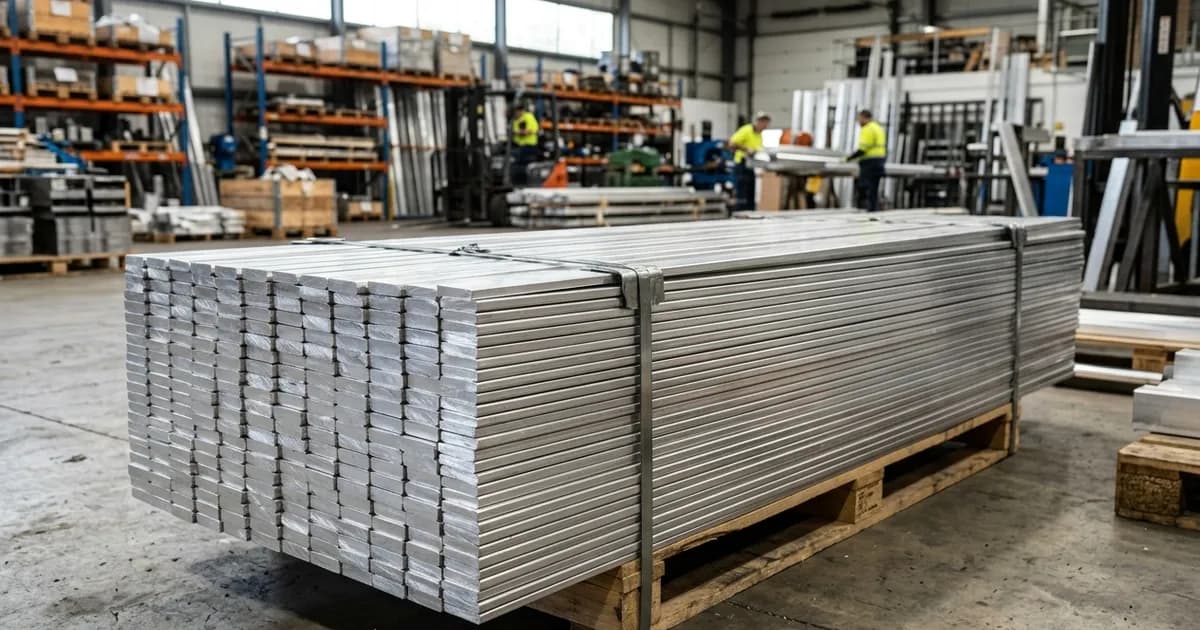
In power transmission sub-stations, medium-voltage (11kV / 33kV) switchgear enclosures, Motor Control Centers (MCC), and heavy industrial busduct trunking across India, the electrical conductor of choice is Jindal Aluminium electrical busbars.
With copper prices remaining exorbitantly high, electrical EPC contractors and panel builders have long standardized on aluminium. However, designing high-reliability power distribution systems requires adhering strictly to Indian Standard IS 5082 (Specification for wrought aluminium and aluminium alloy bars, rods, tubes and sections for electrical purposes) and international standard IEC 61439.
Failure to properly account for alloy conductivity, short-circuit dynamic electromagnetic forces, joint contact resistance, and enclosure temperature rise limits can cause severe catastrophic switchgear flashovers. In this engineering guide, Imperial Metal Mart explores the critical electrical and mechanical rules governing Jindal busbar design.
IS 5082 Compliance: Electrical Alloys 6101 vs. 6063 vs. 1350
Indian Standard IS 5082 recognizes distinct aluminium grades formulated specifically for electrical applications:
| Alloy Specification | Electrical Conductivity (% IACS) | Yield Strength (0.2% Proof) | Thermal Creep Resistance | Primary Switchgear Use |
|---|---|---|---|---|
| Alloy 6101-T6 (IS Grade 63401) | 57.0% – 58.5% IACS | ≥ 200 – 220 MPa | Superior | High-voltage switchboards, busducts, sub-station risers |
| Alloy 6063-T6 (IS Grade 63400) | 53.0% – 55.0% IACS | ≥ 190 – 214 MPa | High | Commercial panels, distribution boards, MCC busbars |
| Alloy 1350 / EC Grade (IS Grade 19501) | 61.0% – 61.8% IACS | ≥ 65 – 85 MPa (Soft) | Poor (Prone to joint loosening) | Flexible links, short jumpers, non-structural joints |
Short-Circuit Withstand & Electromagnetic Forces
Under a major electrical fault (e.g., 50 kA for 1.0 second), massive electromagnetic repulsion forces develop between adjacent phase conductors:
Where:
F = Dynamic peak electromagnetic force (in N/meter of busbar length)
I_peak = Peak prospective short-circuit current (in kA, typically 2.1 × I_rms)
d = Center-to-center phase spacing between busbars (in meters)
If the busbars lack adequate section modulus or if the epoxy/SMC busbar support insulators are spaced too far apart, the bars will violently twist and touch, causing a catastrophic arc flash explosion. Jindal 6101-T6 and 6063-T6 bars provide the high flexural yield strength needed to pass rigorous CPRI (Central Power Research Institute) type testing.
Current-Carrying Capacity (Ampacity) & Temperature Rise Limits
Under IS 8623 / IEC 61439, the maximum continuous operating temperature of an aluminium busbar in a ventilated panel is typically capped at 90°C (a ΔT rise of 50°C above a standard 40°C Indian ambient):
| Busbar Section Size | Cross-Section Area | 1 Bar per Phase (Amps) | 2 Bars per Phase (Amps) | 3 Bars per Phase (Amps) |
|---|---|---|---|---|
| 50 mm × 6 mm | 300 mm² | 390 A | 660 A | 920 A |
| 50 mm × 10 mm | 500 mm² | 540 A | 910 A | 1,260 A |
| 75 mm × 10 mm | 750 mm² | 750 A | 1,280 A | 1,760 A |
| 100 mm × 10 mm | 1,000 mm² | 960 A | 1,620 A | 2,240 A |
| 120 mm × 10 mm | 1,200 mm² | 1,120 A | 1,890 A | 2,610 A |
4 Rules for Bimetallic Copper-to-Aluminium Joints
When connecting aluminium busbars to incoming copper transformer cables or molded case circuit breaker (MCCB) copper terminals, direct metal contact will cause rapid galvanic corrosion. Follow these four mandatory joint rules:
- Electro-Tin Plating: Specify factory electro-tin plated aluminium busbars (minimum 8 to 12 microns). Tin acts as an electrochemical buffer between copper and aluminium.
- Bimetallic Friction-Welded Washers / Lugs: Use bimetallic plates (molecularly bonded copper on one side, aluminium on the other) so copper only touches copper and aluminium only touches aluminium.
- Conical Belleville Spring Washers: High-tensile Belleville washers absorb differential thermal expansion during peak load cycles without losing contact clamping pressure.
- Antioxidant Contact Grease: Coat mating surfaces with a zinc-suspended neutral electrical joint compound before torquing to exclude moisture and air.
Frequently Asked Questions
What is the difference between IS 5082 and general extrusion standard IS 733?
IS 733 is a general mechanical engineering specification focusing on tensile strength and dimensional tolerances. IS 5082 specifically mandates minimum electrical conductivity (% IACS), maximum electrical resistivity (in μΩ·cm at 20°C), and strict chemical limits on iron and silicon to guarantee current-carrying performance.
Can Jindal aluminium busbars be supplied with radius edges?
Yes. Jindal Aluminium extrudes electrical flats with full radius edges (semi-circular sides) or round corner edges. Radius edges eliminate sharp 90° corners, significantly reducing dielectric electrical corona discharge and preventing heat shrink insulation sleeves from splitting.
Where can I buy genuine Jindal electrical busbars in Delhi NCR?
Imperial Metal Mart is an authorized stockist of Jindal Aluminium busbars on Desh Bandhu Gupta Road, Paharganj, New Delhi, supplying certified flats in Alloy 6101-T6 and 6063-T6 with full Mill Test Certificates and ready wholesale dispatch.
Source Certified Jindal Busbars in Delhi NCR
Imperial Metal Mart stocks full inventories of certified Jindal electrical busbars conforming to IS 5082 in Paharganj, New Delhi, with guaranteed conductivity.