

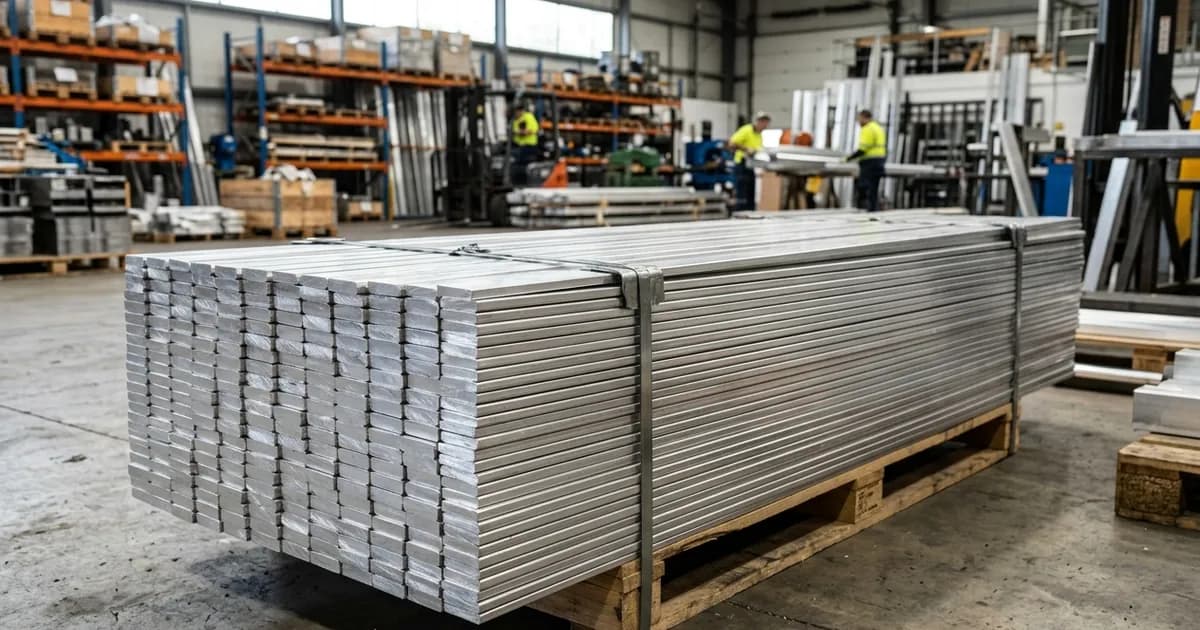
In precision machine shops, tool and die fabrication centers, aerospace sub-tier workshops, and marine fabrication yards across India, solid aluminium industrial flat bars are the indispensable raw stock of manufacturing. Unlike thin architectural trims (which measure just 1.5mm to 3mm thick), industrial flats encompass heavy-gauge extruded rectangular bars ranging from 6mm up to 50mm+ in thickness and up to 300mm in width.
When milling precision mounting baseplates, robotic arm brackets, welding fixtures, or high-ampacity electrical links, choosing the wrong alloy or edge condition can cause tool gumming, excessive part warpage during CNC pocketing, or catastrophic brittle failure under dynamic shock loads.
Extruded from virgin billets by Jindal Aluminium and stocked in ready bundles by Imperial Metal Mart in Paharganj, New Delhi, industrial flat bars are available in specialized alloys. In this engineering manual, we compare the mechanical attributes of Alloys 6082, 6061, and 6063, analyze edge styles, and provide CNC machining feeds and speeds.
Alloy Showdown: 6082-T6 vs. 6061-T6 vs. 6063-T6
Choosing the optimal alloy temper requires matching tensile yield strength, impact resistance, and machinability to your end application:
| Mechanical Property | Alloy 6082-T6 (Structural) | Alloy 6061-T6 (Aerospace) | Alloy 6063-T6 (Architectural/Busbar) |
|---|---|---|---|
| Yield Strength (0.2% Proof Stress) | ≥ 260 – 280 MPa | ≥ 240 – 276 MPa | ≥ 190 – 214 MPa |
| Ultimate Tensile Strength (UTS) | 310 – 340 MPa | 290 – 310 MPa | 220 – 245 MPa |
| Brinell Hardness (HBW) | 95 – 100 HB | 90 – 95 HB | 70 – 75 HB |
| CNC Machinability & Chip Breaking | Excellent (Crisp discontinuous chips) | Good | Moderate (Tendency to form continuous curly swarf) |
| Corrosion Resistance (Marine/Outdoor) | Very High | Exceptional | Exceptional |
| Primary Industrial Application | Machine frames, jigs, rail cars, trusses | Defense parts, marine fittings, aerospace | Electrical busbars, heat sinks, trims |
Edge Geometries: Square Edge vs. Radius Edge
Jindal extrudes industrial flat bars with distinct edge geometries depending on mechanical vs electrical end usage:
1. Sharp Square Edge (SE)
Features crisp, precision 90° corners. Essential for machine shop baseplates, welding jigs, and modular machine frames that require flush edge-to-edge butt alignment.
2. Full Radius / Rounded Edge (RE)
Features continuous semi-circular or rounded corner fillets (typically R1.5 to R3.0mm). Reduces dielectric corona discharge in high-voltage switchgear, protects cable insulation from chafing, and prevents operator cuts during assembly.
CNC Machining Guidelines for Aluminium Industrial Flats
To maximize tool life and achieve mirror-smooth surface finishes (Ra ≤ 0.8 μm) when milling Jindal flat bars:
- Tool Selection: Use solid carbide end mills with 2 or 3 polished flutes, deep chip gullets, and a high helix angle (35° to 45°) to evacuate high-volume aluminium chips rapidly.
- Cutting Speeds: Run spindle speeds delivering surface cutting speeds of Vc = 400 to 800 m/min.
- High-Pressure Coolant: Always apply high-pressure water-soluble flood coolant or micro-mist lubrication. Cutting aluminium dry causes friction melting, welding the chips directly onto the cutting flutes.
- Stress Relieving for Thin Baseplates: When machining deep pockets in wide flat bars, internal residual extrusion stresses can cause the plate to bow slightly. Take roughing cuts equally on both faces before making final finishing passes.
Frequently Asked Questions
Can Jindal aluminium flat bars be welded without cracking?
Yes. Both 6082-T6 and 6061-T6 are readily weldable using TIG (GTAW) or MIG (GMAW) welding processes. Use ER4043 filler wire for general assemblies or ER5356 filler wire when higher weld joint shear strength or subsequent anodizing is required.
What is the thickest industrial flat bar available from Jindal stockists?
Standard stocked thicknesses range from 6mm up to 25mm, with heavy industrial plates and flats up to 50mm (2 inches) thick available in ready stock or custom extrusion lots through Imperial Metal Mart in New Delhi.
How can I verify the chemical composition of my flat bars?
Every batch of genuine Jindal Aluminium industrial flats supplied by Imperial Metal Mart is accompanied by a certified Mill Test Certificate (MTC) detailing spectral optical emission chemical analysis (Silicon, Iron, Copper, Manganese, Magnesium, Chromium, Zinc, Titanium) and mechanical tensile test results conforming to Indian Standard IS 733.
Source Heavy Industrial Flat Bars in Delhi NCR
Imperial Metal Mart maintains extensive inventories of Jindal Aluminium flat bars in Alloys 6082-T6, 6061-T6, and 6063-T6 in Paharganj, New Delhi, with custom cut-to-length services.