

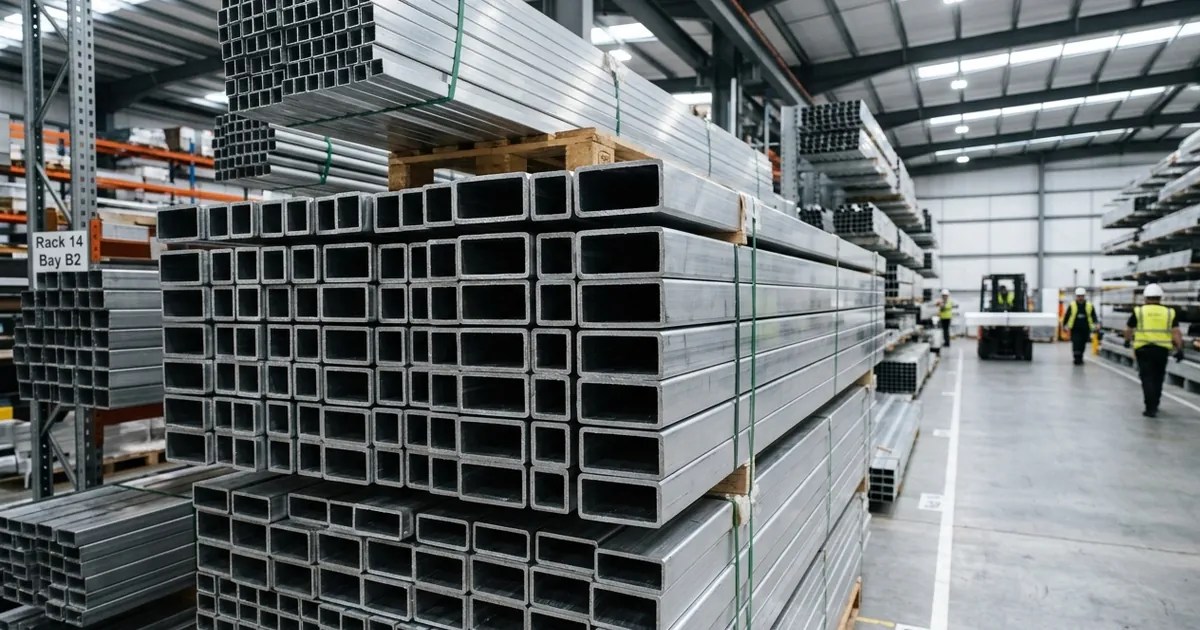
In precision mechanical fabrication, aerospace hydraulics, heat exchanger coils, and pneumatic automation, specifying "aluminium tube" without defining the manufacturing process is a recipe for catastrophic field failure. A tube engineered for a stationary architectural handrail cannot withstand the cyclic burst pressures of a compressed air manifold or the severe tensile hoop stresses of high-speed fluid transfer.
When purchasing from Jindal Aluminium, two primary manufacturing methodologies exist: Structural Extruded Tubes (porthole/bridge die) and Seamless Mandrel Extruded / Cold Drawn Tubes.
Understanding the grain structure, longitudinal weld seam mechanics, hoop burst pressure calculations, and rotary draw bending physics is critical for any engineering workshop. In this guide, Imperial Metal Mart breaks down the engineering criteria governing tube selection.
Manufacturing Mechanics: Porthole Extruded vs. True Seamless
1. Structural Extruded Tubes (Porthole Die)
Solid heated aluminium billets are forced through a multi-chamber porthole or bridge die. The metal splits into streams around core supports and pressure-welds back together in the welding chamber before exiting the die aperture.
- • Internal Structure: Contains 2 to 4 longitudinal extrusion weld seams (invisible to the naked eye).
- • Best For: Structural framing, railings, furniture, bus bodies, and low-pressure ducting.
2. True Seamless Mandrel Tubes
Extruded from a hollow cylindrical billet using a floating or fixed internal piercing mandrel. The metal flows continuously in a seamless circular matrix with zero longitudinal weld seams whatsoever.
- • Internal Structure: 100% continuous circumferential grain boundary.
- • Best For: Hydraulic fluid lines, compressed gas cylinders, refrigeration serpentines, and extreme tight-radius rotary bending.
Bursting Pressure Calculation: Barlow's Formula
When pressurized air or fluid flows inside an aluminium tube, internal hydrostatic pressure exerts circumferential tensile stress (hoop stress). Engineers calculate theoretical bursting pressure using Barlow's Formula:
Where:
P = Theoretical Bursting Pressure (in MPa or PSI)
S = Minimum Ultimate Tensile Strength (UTS) of the alloy (in MPa)
t = Minimum Wall Thickness (in mm)
D = Nominal Outside Diameter (in mm)
For structural porthole extruded tubes, a weld seam joint efficiency factor (E = 0.80 to 0.85) must be factored in because microscopic inclusion defects at weld planes can fail under cyclic pressure spikes. True seamless tubes operate at E = 1.00.
Mandrel Bending Guide: Eliminating Kinking, Ovality & Wrinkles
Bending an extruded hollow aluminium tube around a circular radius is a complex metallurgical operation. The outer curved wall (extrados) undergoes intense tensile elongation, while the inner wall (intrados) undergoes compressive stress:
| Common Bending Defect | Underlying Root Cause | Engineering Solution |
|---|---|---|
| Extrados Wall Cracking / Snapping | Alloy temper is too hard (e.g. fully aged 6082-T6) | Switch to 6063-T4 or annealed 6063-O temper; increase bend radius to ≥ 3×OD |
| Intrados Tube Wrinkling | Thin wall buckles under unsupported compression | Use a wiper die and multi-ball flexible internal steel mandrel |
| Cross-Section Flattening (Ovality) | Lack of internal core support during rotary draw | Pack cavity with dry silica sand or use internal polyurethane bending plugs |
Frequently Asked Questions
Can porthole extruded aluminium tubes be used for air conditioning refrigerant lines?
No. Refrigerant gases (such as R-410A or R-32) operate at very high operating pressures (exceeding 400 PSI) with extreme molecular penetration. Seamless copper or cold-drawn seamless aluminium tubing is mandatory to prevent microscopic gas seepage along longitudinal extrusion seams.
What is the minimum bend radius for Jindal 6063-T6 tubes?
For fully heat-treated 6063-T6 tubes, the recommended minimum centerline bend radius (CLR) is 3 times the outer diameter (3D) to avoid tensile cracking along the outer wall. If tighter bends (e.g., 1.5D to 2D) are required for custom furniture or condenser serpentines, specify 6063 in the T4 or O (annealed) condition.
Does Imperial Metal Mart supply pressure-tested aluminium tubes?
Yes. Imperial Metal Mart can supply genuine Jindal Aluminium tubes accompanied by hydrostatic test documentation and eddy-current non-destructive flaw inspection reports for critical industrial applications.
Source Pressure-Rated Jindal Aluminium Tubes
Imperial Metal Mart stocks certified round pipes, seamless tubes, and structural hollow profiles in Delhi NCR, backed by official Mill Test Certificates.